The consistency rule links a counterfactual intervention to the factual world. When the hypothetical condition matches the condition that actually occurred, the hypothetical outcome equals the observed outcome. Formally, P(Yₓ₌ₓ | X = x, Z = z) = P(Y | X = x, Z = z). section 8.2.5 section 8.2.4
Apply the rule by checking whether the factual and hypothetical conditions overlap without conflict:
- Write the factual conditions and the hypothetical intervention separately. section 8.2.4
- If the intervention sets a variable to the value already observed, remove that hypothetical condition from the notation. section 8.2.5 section 8.2.4
- Retain conflicting interventions as genuine counterfactual questions; consistency does not collapse them. section 8.2.5 section 8.2.4
In-game purchases
Suppose a player actually has low side-quest engagement and $75 in-game purchases. The query P(Iᴱ⁼ˡᵒʷ | E = “low”, I = 75) asks about the same engagement level that is factually observed, so consistency reduces it to P(I | E = “low”, I = 75): the outcome is $75. By contrast, asking about high engagement remains a conflicting counterfactual. section 8.2.5
Figure 8.4 Elements of a conditional counterfactual hypothetical formalized in counterfactual notation
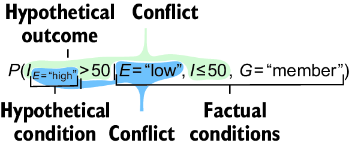
Use the notation diagram to distinguish factual conditions, hypothetical conditions, and hypothetical outcomes before applying consistency. section 8.2.4
