A constrained traversal navigates a knowledge graph through specified entities, relationships, and conditions, turning natural-language intent into an executable query. A request for red Camaros seen in an area at a time can constrain vehicle color and model, ownership, camera location, and capture relationships. section 14.3.1
Construct a constrained traversal by:
- Mapping query concepts to graph entities and properties. section 14.3.1
- Identifying the relationships that connect those entities. section 14.3.1
- Applying conditions, then composing traversals or aggregations into more complex queries. section 14.3.1
Figure 14.2 Translating a natural-language query (“Red Camaro spotted in this area at this time”) into a formal Cypher query. The translation occurs in three stages: (1) parsing the natural-language request into semantic components, (2) mapping these components to schema elements (Vehicle, CameraEvent, and ANPRCamera nodes with their relationships), and (3) constructing a formal Cypher query with the appropriate traversal patterns and constraints. Domain concepts are systematically transformed into graph database operations, demonstrating the bridge between user intent and executable queries.
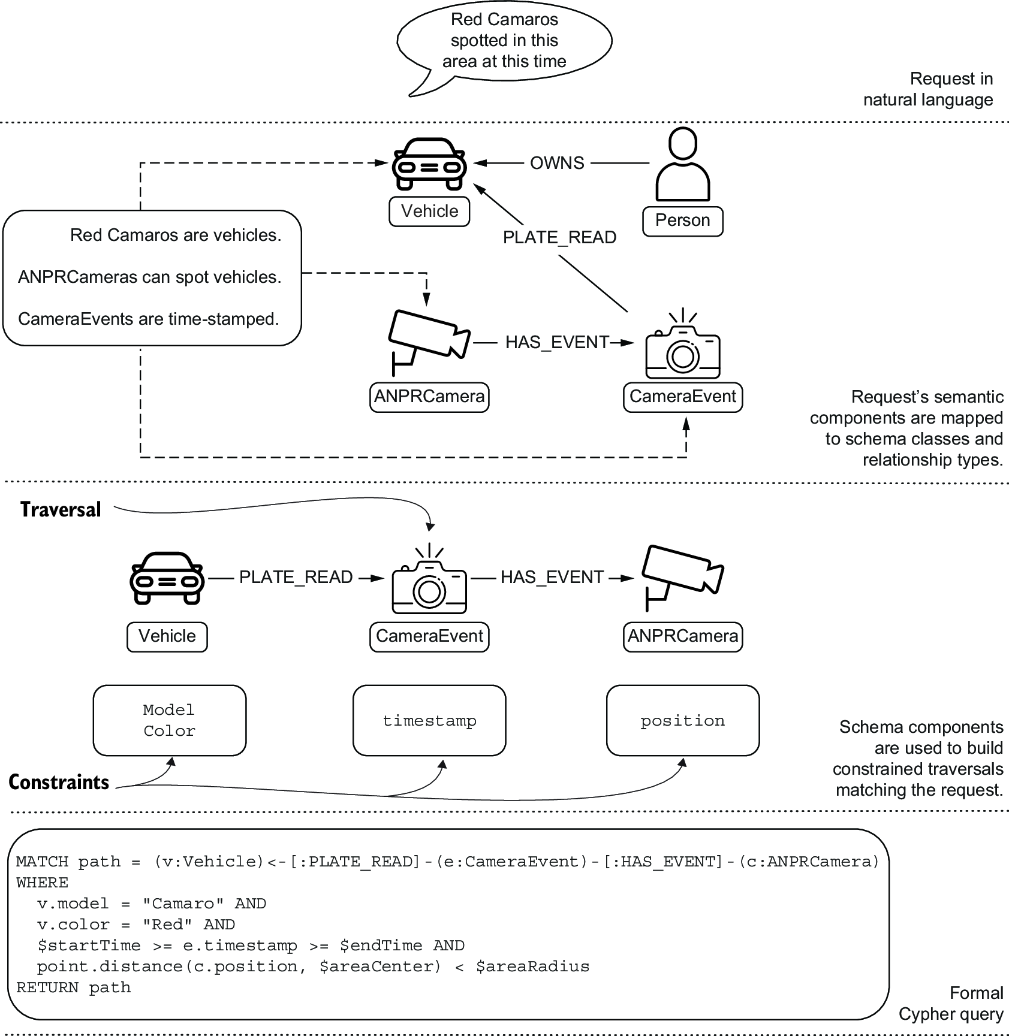
Shows the pipeline from natural-language parsing through schema mapping to a formal Cypher traversal. section 14.3.1
