A constraint-based algorithm infers candidate causal graphs by finding conditional independencies in observed data and retaining DAGs whose d-separation constraints match those findings. It works in reverse: empirical independence evidence narrows the candidate graph space iteratively. section 4.6.1 section 4.6.2
A typical constraint-based workflow:
- Test conditional-independence relationships in the available data. section 4.6.2
- Translate each detected independence into a d-separation constraint. section 4.6.2
- Iteratively narrow the candidate DAG space to graphs consistent with those constraints. section 4.6.2
- Use prior knowledge about required or forbidden edges when the DAG space is large. section 4.6.1
PC algorithm and its assumptions
The PC algorithm is a well-known constraint-based method. Its interpretation relies on causal faithfulness: observed conditional independencies must correspond to d-separation statements. Faithfulness violations can make valid distributional independencies impossible to represent with a DAG, while latent variables can prevent required conditioning tests and distort the returned graph. section 4.6.2
Figure 4.22 Assume this is the true causal DAG. Here, B, C, and D are conditionally independent, given A.
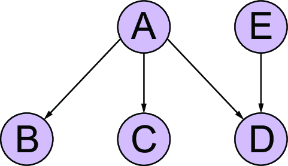
Use the figure to inspect conditional independence among observed variables given a parent variable, then compare it with the latent-variable case. section 4.6.2
