liveBook · Manning

Constructive solid geometry

As explained in Robotics for Programmers

Constructive solid geometry is a modeling technique that builds complex solids by applying Boolean operations to simpler solids.

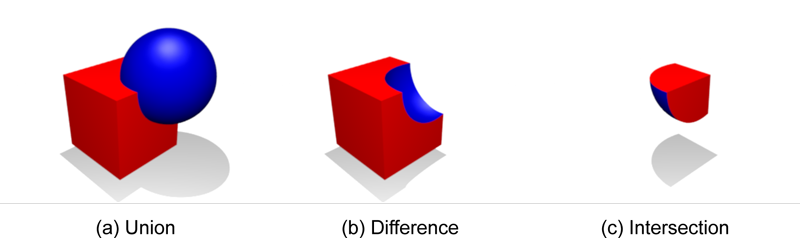
Constructive solid geometry (CSG) models complex solids by combining simpler geometric primitives with Boolean operations. section 6.1.5

Use three core operations:

  • Union merges the volumes enclosed by either object. section 6.1.5
  • Difference removes the overlapping part of one object from another. section 6.1.5
  • Intersection retains only the volume shared by both objects. section 6.1.5
Figure 6.13 Constructive solid geometry (CSG) creates complex 3D shapes by combining simple geometric primitives with Boolean operations such as union, difference, and intersection. [4]
CH06 Fxx bihlmaier csg boolean operations

See how primitive solids become complex three-dimensional shapes through union, difference, and intersection. section 6.1.5

How Robotics for Programmers covers it

How deep it goes
Defines three Boolean operations and their volume effects, but stops short of implementation details.
Examples
Uses unions, differences, and intersections of simple solids as the central geometric examples.
What it assumes
Assumes familiarity with simple geometric shapes and basic three-dimensional volume.
What you can do after
Evaluate/understand how Boolean operations construct complex three-dimensional solids from simpler shapes.
How it connects
Connects Boolean operations with geometric primitives, meshes, curve models, and boundary representation.

Related concepts

This explainer was generated by Manning's knowledge graph from the text of Robotics for Programmers. The section links point to the parts of the book it draws on.