A container platform provides tools and services for building, running, networking, and managing containers. Docker can run multiple containers on one machine, connect them through a virtual network, and support mixed processor architectures such as Intel and Arm. section 1.3
Local container tools do not automatically provide multi-server scaling or high availability. For that, use a managed cloud container service or Kubernetes. Cloud services run containers reliably without requiring teams to manage the underlying infrastructure. section 1.3 section 14.5
Choose a platform by checking:
- Platform support for Windows, Linux, and Arm. section 14.5
- Image builders, source-control integration, and CI/CD support. section 14.5
- Docker Compose compatibility, observability, configuration, sensitive-data handling, and identity-based service integration. section 14.5
- Ease of adoption, feature growth, and the path beyond a simple container service. section 14.5
From laptop to production
Build and run an application with Docker first, then compare managed container services against Kubernetes for production. Docker, Podman, and other OCI-based tools can exchange containers, while Kubernetes or a managed service supplies broader operational scale. section 1.3 section 22.3
Figure 1.5 A single cluster of servers running Docker can run every type of application, and you build, deploy, and manage them all in the same way no matter what architecture or technology stack they use.
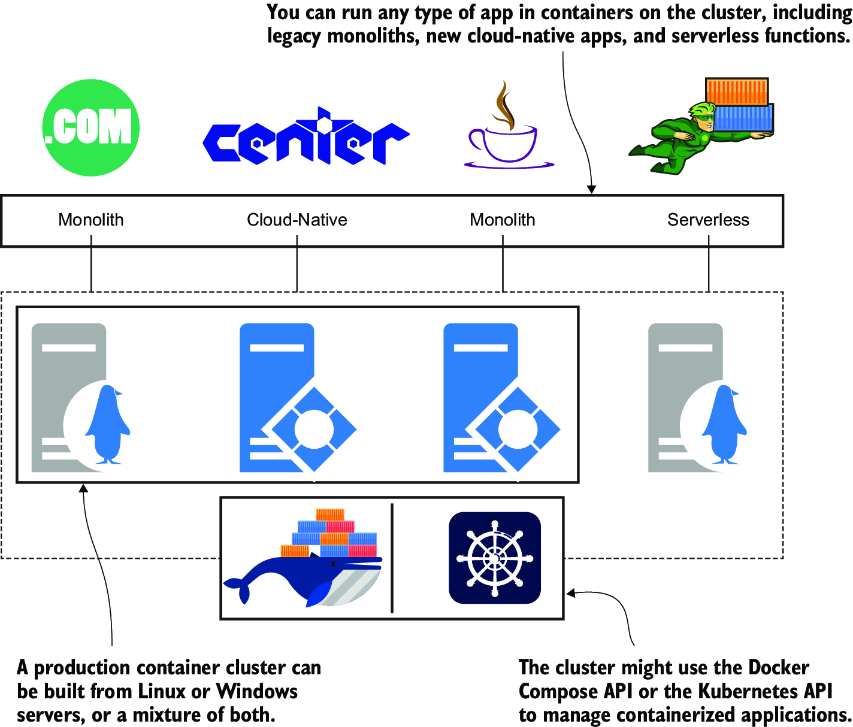
Use the cluster diagram to see how one Docker platform can build, deploy, and manage applications across different architectures and technology stacks. section 1.1.4
