Content-aware chunking adapts segment boundaries to a document’s structure instead of applying one fixed strategy everywhere. It helps preserve related information for retrieval: small chunks can separate a policy’s eligibility rules from its name, while large chunks can include unrelated material and dilute relevance. section 4.4.2
Choose parsing boundaries to match the content:
- For legal documents, use section headers or numbered clauses to keep complete concepts together. section 4.4.2
- For narrative text, split at paragraph breaks and enforce a minimum length to avoid fragments. section 4.4.2
- For code documentation, preserve code fences, function signatures, and related explanations in the same chunk. section 4.4.2
- When specialized parsing does not fit, use overlapping sliding windows as a fallback. section 4.4.2
Match boundaries to the document
Keep a “Paid Time Off Policy” cohesive rather than splitting its rules across fragments; in technical documentation, keep API parameters with their descriptions. section 4.4.2
Figure 4.6 Small chunks (top) may separate related information, causing retrieval to miss crucial context when answering specific queries. Large chunks (bottom) keep related information together but may have diluted relevance scores because they include unrelated content. This fundamental tradeoff significantly affects your RAG system’s ability to find and retrieve appropriate information.
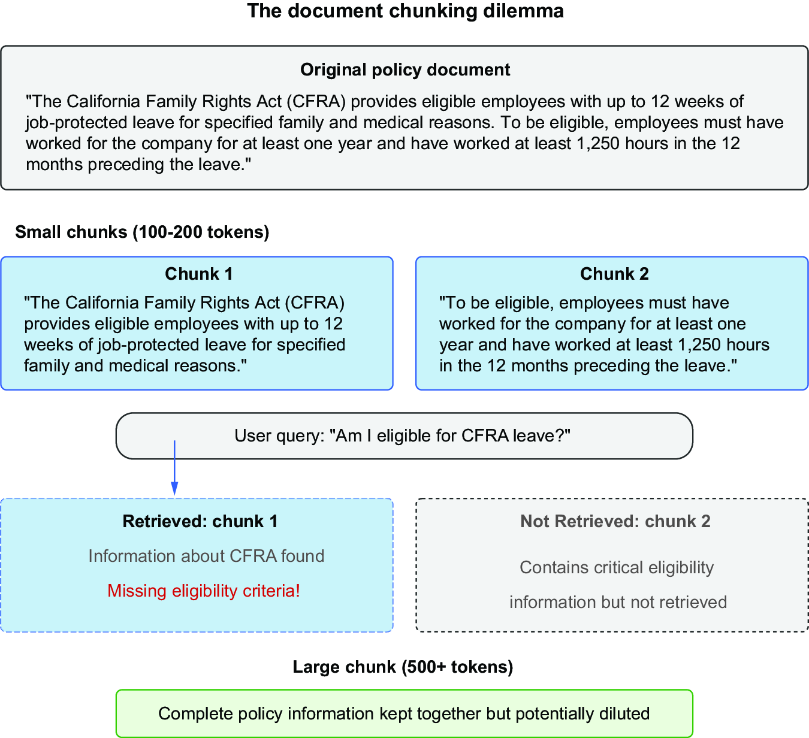
Compare how small chunks can lose necessary context while large chunks can weaken relevance. section 4.4.2
