Context-aware recommendation adapts item ranking to situational information such as time, location, device, or season. The same user and item can have different relevance in different circumstances: a long comic may be unsuitable on a mobile lunch break but appropriate on a weekend laptop session. section 1.3.3
Context is usually layered onto content-based or collaborative filtering rather than used alone. A typical pipeline generates candidates with an existing recommender, then filters or reranks them using contextual features; the candidates may stay fixed while their order changes. section 1.3.3
One item, three contexts
For Alice, Thorgal is low relevance on a mobile device during a 12:30 PM lunch break, highly relevant on a laptop during a weekend morning, and moderately relevant late at night because fatigue matters. section 1.3.3
A practical context-aware recommender must account for:
- Capturing contextual signals such as time, location, device, and season. section 1.3.3
- Integrating context with candidate generation and reranking instead of treating it as a standalone recommendation source. section 1.3.3
- Handling increased feature dimensionality, unclear contextual patterns, infrastructure requirements, and privacy concerns around location or device data. section 1.3.3
Figure 1.5 Recommender systems can be implemented using different types of data. Most systems use one or more of three distinct categories: content metadata, behavioral data, and contextual data.
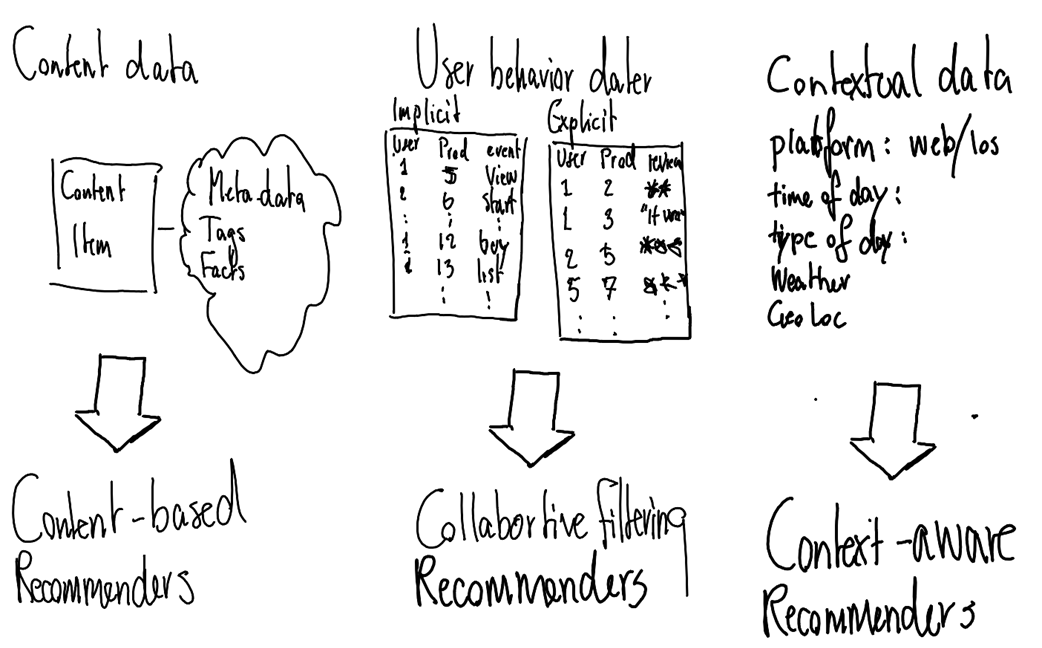
Use the data-type comparison to distinguish contextual data from content metadata and behavioral data. section 1.3