A contextual bandit makes targeted, repeated decisions by predicting a short-term business-metric outcome for each available action in the current context. It fits prediction models from logged decisions and rewards offline, then uses a policy online to choose actions. This suits personalized services such as content, advertising, music, and movie recommendation, where different users may prefer different options. section 5.0 section 5.1
Figure 5.1 A generic contextual bandit (CB). A CB consists of offline and online parts. In the offline part, you fit a model that predicts the business metric. Online, the system usually makes prediction-based decisions that exploit the model to increase the business metric. Sometimes it makes decisions randomly—it “explores”—to collect novel data for the next offline fit.
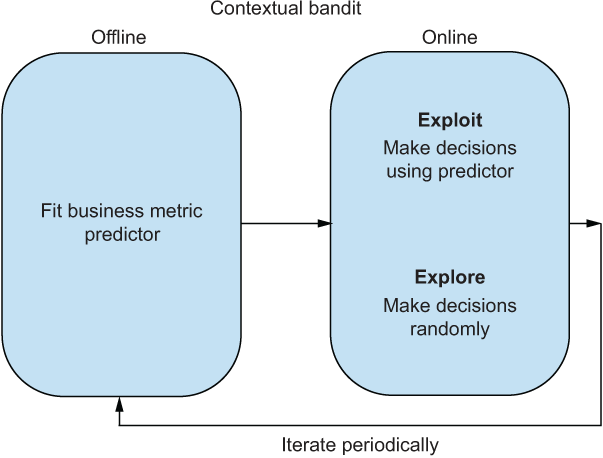
The system alternates between fitting a reward-prediction model from logs and making online decisions; occasional random actions collect new data. section 5.1
In a recommender, the user is the context, a displayed post is the action, and viewing time is the reward. A model predicts reward from the context and action; a greedy policy selects the action with the largest predicted reward. Models can be refit daily as fresh logs arrive. section 5.1.1 section 5.1.2
Greedy social-media recommender
Represent each user with a feature vector and log each displayed post with its viewing time. Fit a separate reward model for each post from its logged contexts and rewards. For an arriving user, score every post and display the one with the highest predicted viewing time. Random initial model parameters can produce initial logs, but performance begins poorly before the system learns from them. section 5.1.1 section 5.1.2 section 5.1.3
Pure exploitation creates missing counterfactuals: the system observes rewards only for what it chose to show. Epsilon-greedy exploration addresses this by choosing a random action a small fraction of the time and using the greedy policy otherwise. The resulting data can reduce prediction bias and feedback loops, though exploration trades some immediate reward for information. section 5.0 section 5.2.2
Use a contextual bandit under these operating constraints:
- Optimize a metric directly caused by one action, such as an ad click or starting a suggested song. section 5.1.3
- Do not treat it as a solution for multistep returns where earlier actions change the meaning or consequences of later ones. section 5.1.3
- Plan for cold start, model fitting, exploration, and policy constraints such as safety or business rules. section 5.1.2 section 5.4
- Validate any system change with an A/B test, including new features, exploration changes, or safety checks. section 5.4
A contextual bandit extends a multi-armed bandit by conditioning each action on context. It is also a special case of reinforcement learning in which decisions do not affect the next context, and it differs from supervised learning because its training samples are selected by a policy rather than randomly sampled. section 5.2.2


