liveBook · Manning

Continuity

As explained in Everyday Data Visualization

A perceptual organization principle in which elements following a smooth or continuous path are seen as related.

Continuity is the tendency to group elements aligned along a smooth line or curve. Even when outlines or segments are missing, the eye follows the implied path and treats the pieces as related. section 2.2.5

Designers and data communicators use continuity in familiar ways:

  • Logos can remain readable or recognizable without complete outlines because aligned marks suggest letters, shapes, or figures. section 2.2.5
  • A donut chart remains legible as a partially missing circle because viewers mentally complete the continuous path. section 2.2.5
  • Sorted bars are easier to scan because their bases form a straight line and their ends create a diagonal progression. section 2.2.5
  • Sort by length only when category order is not meaningful; sorting a time series would scramble its chronology. section 2.2.5
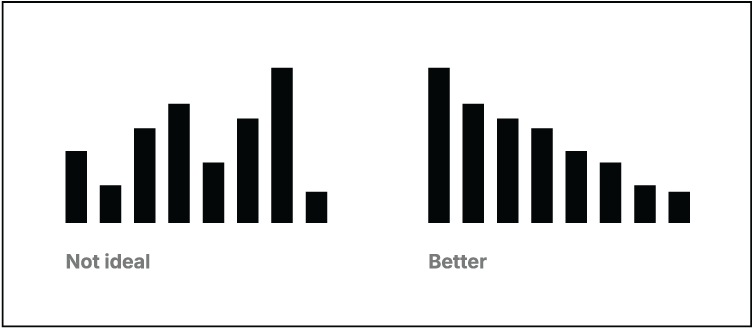
Figure 2.15 Principle of continuity
02-15

Use the continuity figure to see how alignment and ordered bar lengths create a readable visual path. section 2.2.5

How Everyday Data Visualization covers it

How deep it goes
Defines alignment along lines and curves, then explains examples and sorting caveats without developing perceptual mechanisms.
Examples
Uses recognizable logos, text baselines, donut charts, and sorted horizontal or vertical bar charts.
What it assumes
Assumes only familiarity with everyday visual perception and basic charts; introduces the Gestalt framing conversationally.
What you can do after
Evaluate/understand it by arranging visual elements along coherent paths and protecting meaningful category or time order.
How it connects
Connects continuity to closure, connection, Gestalt principles, grouping, alignment, and data visualization.

Related concepts

This explainer was generated by Manning's knowledge graph from the text of Everyday Data Visualization. The section links point to the parts of the book it draws on.