Continuous delivery keeps changes of all types—features, configuration, fixes, experiments, infrastructure, applications, databases, and static resources—releasable for safe, rapid, sustainable production delivery. A pipeline automates the path from source to production, improving reliability, predictability, visibility, and risk control. section 12.1
A practical continuous-delivery approach emphasizes:
- Following continuous integration: frequent check-ins trigger automated builds and tests before delivery. section 12.1
- Keeping integration manageable through trunk-based development; long-lived branches create conflicts and manual work that can stall CI. section 12.1.5
- Distinguishing delivery from deployment: continuous deployment adds automatic promotion to user environments without manual intervention. section 12.2
Cloud Run deployment pipeline
A Google Cloud implementation can monitor Cloud Source Repositories, use Cloud Build to trigger deployment after a code merge, and let Cloud Run manage configured blue/green, canary, or rolling traffic shaping. Repository setup includes gcloud initialization, repository creation, authentication, and ordinary Git operations. section 12.4.1
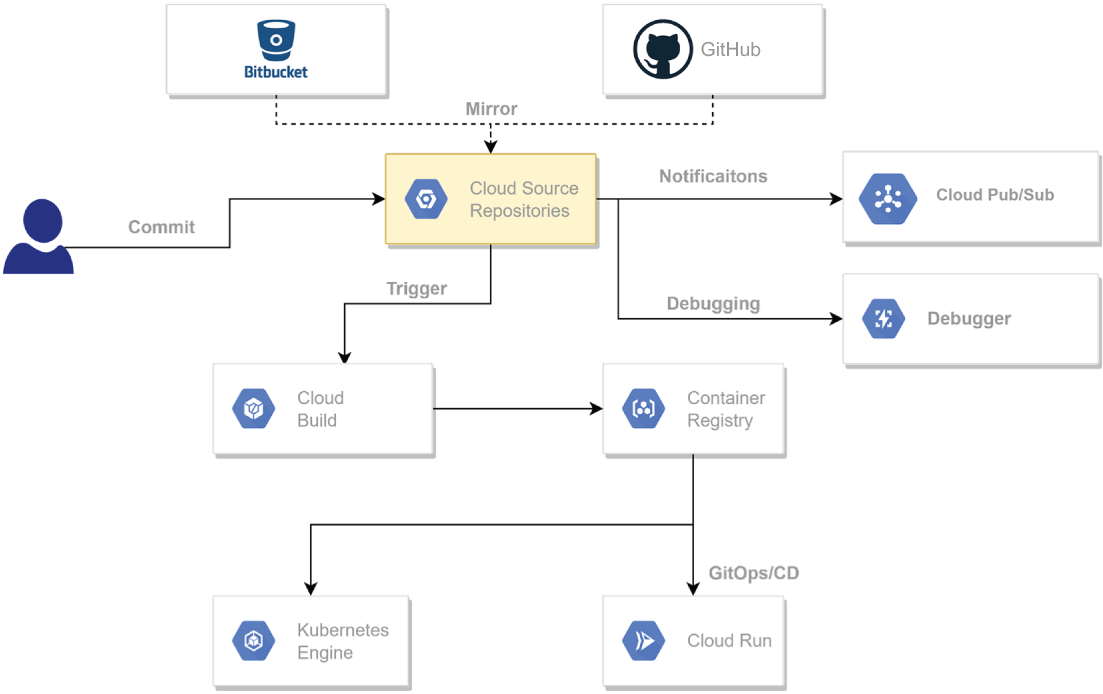
Use the integration diagram to trace how repositories, build automation, event triggers, and Cloud Run deployment fit together. section 12.4.1
