Continuous deployment automatically sends every commit that passes all delivery-pipeline stages to production without human intervention. It extends continuous delivery, which automates deployment and testing in increasingly production-like environments but may require an on-demand trigger. section 8.3
A continuous-deployment pipeline typically coordinates:
- A source-code repository containing code, tests, configuration, and infrastructure files. section 8.3
- Automated builds that package code and run developer-focused unit and component tests. section 8.3
- A versioned artifact repository holding passing release candidates and metadata for deployment. section 8.3
- Automated higher-environment tests covering acceptance, performance, security, and other criteria before production deployment. section 8.3
The practice reduces deployment risk and delivers a continuous stream of production improvements, but feature flags or keystone interfaces must hide partially built features from users. section 8.3
Figure 8.3 The Acme team’s deployment pipeline
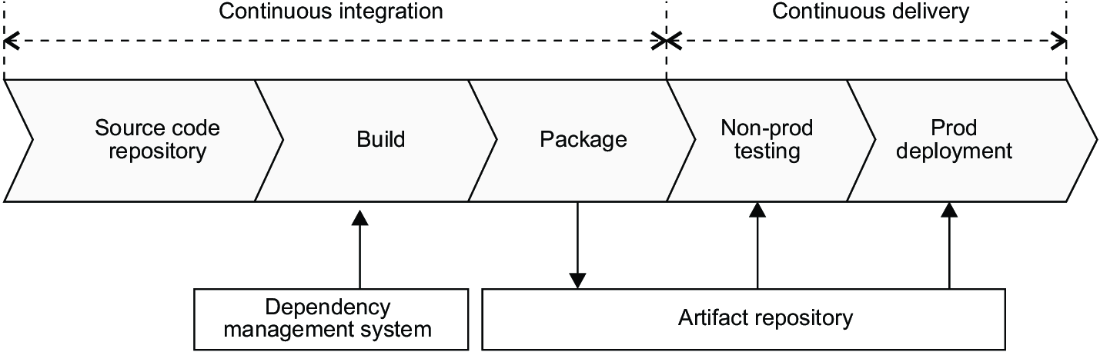
Use the deployment-pipeline diagram to trace how changes move from source and builds through testing toward production. section 8.3





