A continuous-valued target is a prediction target whose possible values lie on a continuous numerical scale. Regression treats these targets as quantities to estimate rather than categories to select or counts to model. section 7.1 section 7.3.1
The choice of loss function determines how prediction errors matter. Squared error penalizes large residuals heavily and is sensitive to outliers; absolute error penalizes errors proportionally, while Huber loss switches between these behaviors at a threshold. section 7.3.1 section 7.3.1
Continuous-valued targets connect regression to several modeling choices:
- Linear regression provides a traditional regression formulation within the generalized linear model framework. section 7.1
- Gradient boosting and Newton boosting use shallow regression trees and can adapt to different loss functions. section 7.3
- Residual magnitude shows the size of each error, while residual sign indicates underestimation or overestimation. section 7.3
Choosing an error penalty
For a continuous-valued prediction, squared error strongly emphasizes an unusually large mistake, whereas absolute error treats that mistake more proportionally. Huber loss offers a threshold-controlled compromise. section 7.3.1
Figure 7.10 Loss and log-likelihood functions for three different types of targets: continuous-valued (left), positive continuous-valued (center), and count-valued (right)
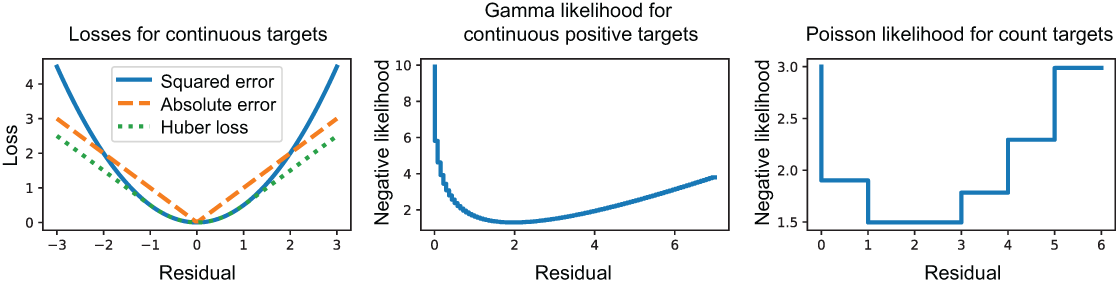
Compare loss and likelihood functions for continuous-valued, positive continuous-valued, and count-valued targets. section 7.3.1
