A contracting path is the encoder side of a U-Net. It processes a noisy image through convolutional and pooling layers, progressively reducing spatial resolution while extracting increasingly abstract feature representations. section 6.2.2 section 6.5
Trace the path through its main operations:
- Convolutional layers detect patterns such as edges, textures, and shapes, building feature maps at successive abstraction levels. section 6.2.2
- Pooling layers reduce feature-map dimensions, improving computational efficiency while encouraging more abstract representations. section 6.2.2 section 6.5
- The resulting features enter the bottleneck, which holds the smallest spatial dimensions and most condensed image information before reconstruction. section 6.5
- Skip connections later pass contracting-path features to the expansive path, helping recover fine-grained details lost during downsampling. section 6.5 section 7.1.1
In diffusion denoising, the path receives a noisy image alongside its time step and label. It extracts multiscale features that support noise prediction, while the expansive path uses the encoded information to reconstruct the image. section 6.2.2
High-resolution U-Nets can add attention within the contracting path. Applied to image pixels, scaled dot-product attention weighs spatial regions dynamically and helps select relevant features among redundant skip-connected representations. section 7.1.1
Figure 6.4 The components of the denoising U-Net model
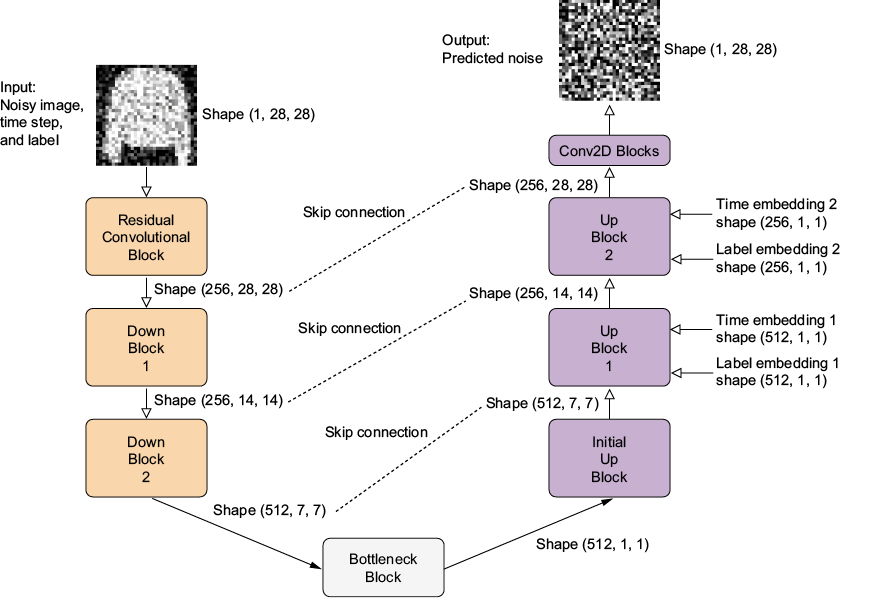
Use the U-Net diagram to follow the contracting path from noisy-image input through convolution and pooling blocks into the bottleneck. section 6.2.2
