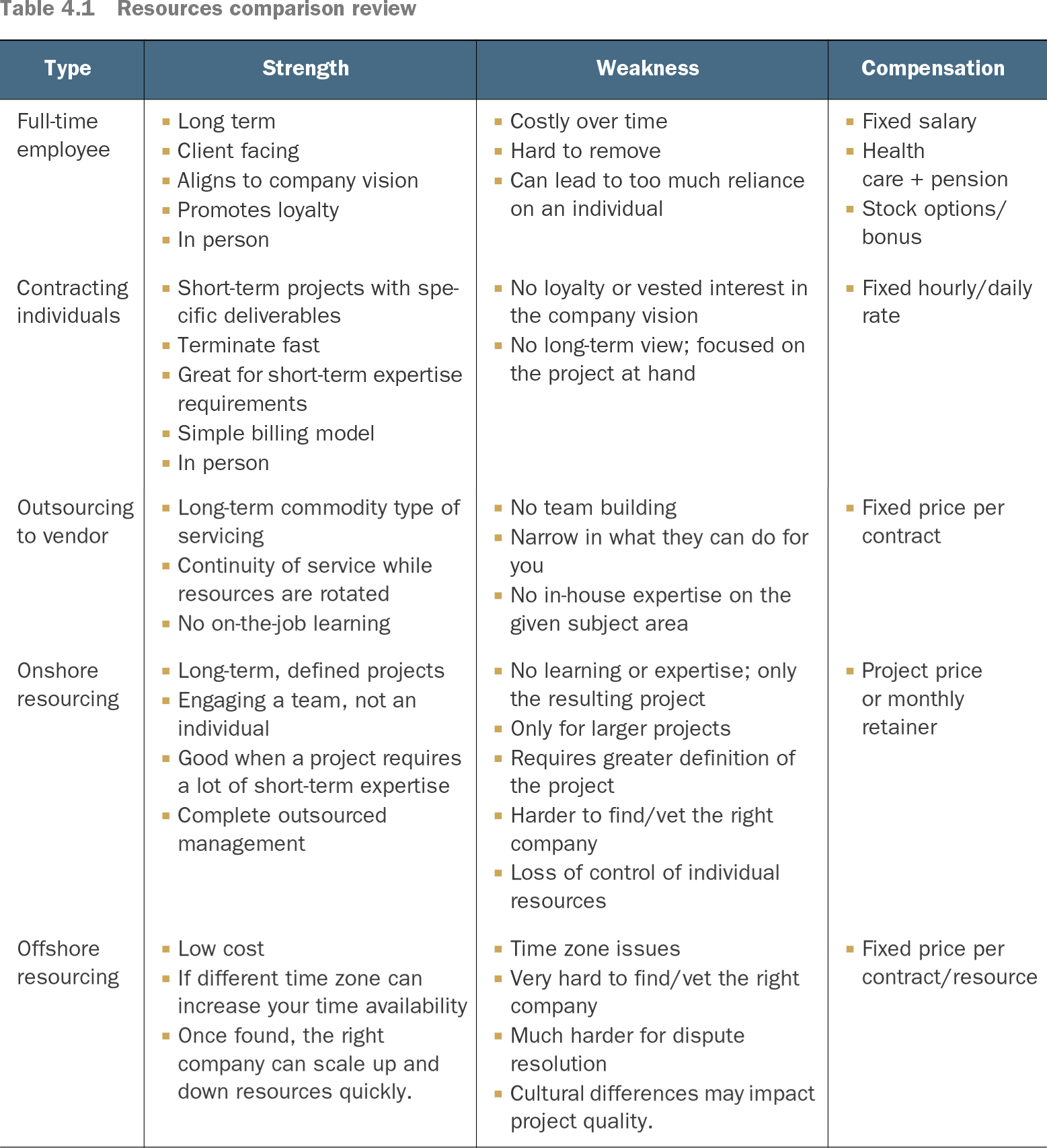
A contractor is a temporary worker paid at a fixed hourly or daily rate to complete a specific task or project. Contractors may come through recruitment agencies, staff augmentation companies, or operate independently. section 4.1.2
Use contractors when work has a defined start and finish, requires skills that will not persist beyond the engagement, or demands short-term expertise. They can expand team capacity without creating a long-term role, but usually bring limited loyalty or interest in the wider company vision. section 4.1.2 section 4.1.6
Evaluate a contractor engagement by checking:
- Define the deliverable, start point, end point, expected skills, and minimum commitment before agreeing terms. section 4.1.2
- Interview agency-provided contractors rather than assuming the agency guarantees quality; emphasize hard technical skills and day-one productivity. section 4.1.2
- Check references for independent contractors and investigate local rules governing extended contractor engagements. section 4.1.2
- Compare the fixed hourly or daily rate with the value of speed, flexibility, and specialized expertise. section 4.1.2 section 4.1.6
A bounded technical engagement
A team might contract someone to design the mobile application's user experience or create database extraction jobs for a data warehouse. Once the defined work is complete, the engagement can end quickly. section 4.1.2
Table 4.1 Resources comparison review (view table figure)
Compare contractors with full-time employees and outsourced vendors by project duration, termination flexibility, continuity, loyalty, and compensation. section 4.1.6