liveBook · Manning

Control group

As explained in Machine Learning System Design

The group in an experiment that receives the existing condition or status quo and provides a comparison for an intervention group.

When an ML change might affect production, a control group keeps the existing system—the status quo—while a treatment group receives the change. Comparing them helps separate the intervention’s effect from outside changes and limits exposure if the new system fails. section 12.2

A control group supports practical A/B testing by:

  • Providing a baseline for key-metric comparisons. section 12.2
  • Helping isolate the effect of a system change while external factors vary. section 12.2
  • Keeping the affected fraction limited by allowing the treatment group to remain small. section 12.2

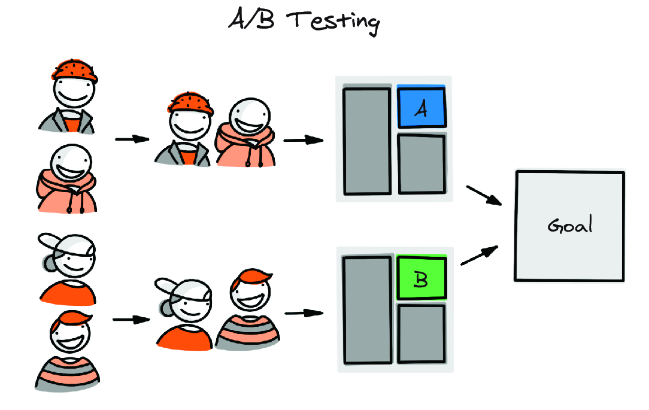
A/B testing split

Split users into two groups: the control group uses the existing version, while the testing group uses the new version. Compare their key metrics before deciding whether the change improves results. section 12.2

Figure 12.6 A/B testing split stage
figure

Use the split-stage figure to see how entities divide between the control and treatment paths. section 12.2


How Machine Learning System Design covers it

How deep it goes
Explains purpose, comparison, exposure control, and external-factor isolation, but does not detail statistical analysis.
Examples
Uses user splits between an existing system version and a new version as the central example.
What you can do after
Evaluate an ML system change by comparing its treatment-group metrics with the status quo.
How it connects
Connects control groups to A/B testing, causal inference, treatment groups, and production metrics.

Also explained in

Compare how 2 books explain control group →

Related concepts

This explainer was generated by Manning's knowledge graph from the text of Machine Learning System Design. The section links point to the parts of the book it draws on.