The control layer is the middle layer of software-defined networking (SDN). It translates application-level network requirements and desired behaviors into forwarding instructions for routers and switches. section 22.2.2
SDN centralizes some or all control-plane functions in a controller with a global network view. Devices retain distributed data-plane functions and forward messages according to the controller’s instructions. section 22.2.2 section 22.4
The control layer connects the other SDN layers through defined interfaces:
- Receives requirements from the Application Layer through the northbound interface (NBI), typically using REST APIs and HTTP messages. section 22.2.2
- Sends actionable instructions to the Infrastructure Layer through the southbound interface (SBI), using protocols such as OpenFlow, NETCONF, OpFlex, SSH, or SNMP. section 22.4
- Applies centralized routing logic instead of requiring every device to calculate routes independently with protocols such as OSPF. section 22.2.2
Figure 22.6 The three layers of SDN architecture: Application, Control, and Infrastructure. The NBI facilitates communication between the Application and Control Layers, and the SBI facilitates communications between the Control and Infrastructure Layers.
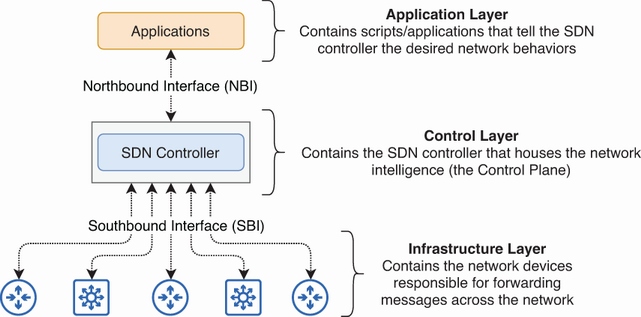
Use the layered architecture diagram to trace requirements from applications through the control layer to infrastructure devices. section 22.2.2
