Convergence is the process by which particles increasingly gather around a promising region of the search space. In particle swarms, stronger social influence favors the swarm’s best discovery, increasing exploitation but risking collapse around a local optimum. section 7.8
Particle behavior depends on the balance between three movement influences:
- Inertia preserves the particle’s current direction. section 7.8
- The cognitive component pulls a particle toward its own best position, supporting exploration. section 7.8
- The social component pulls it toward the swarm’s best position, encouraging convergence. section 7.8
Following the swarm
Imagine tourists choosing where to go. Habit maintains direction, memory points toward a previously successful place, and peer pressure points toward the swarm’s best place. Adding these urges produces a new velocity; adding that velocity to the current position moves the particle. Repeating the update makes the swarm gather, although excessive social influence can make it converge too quickly on a poor region. section 7.8
Figure 7.27 Visualization of convergence of particles and a known surface
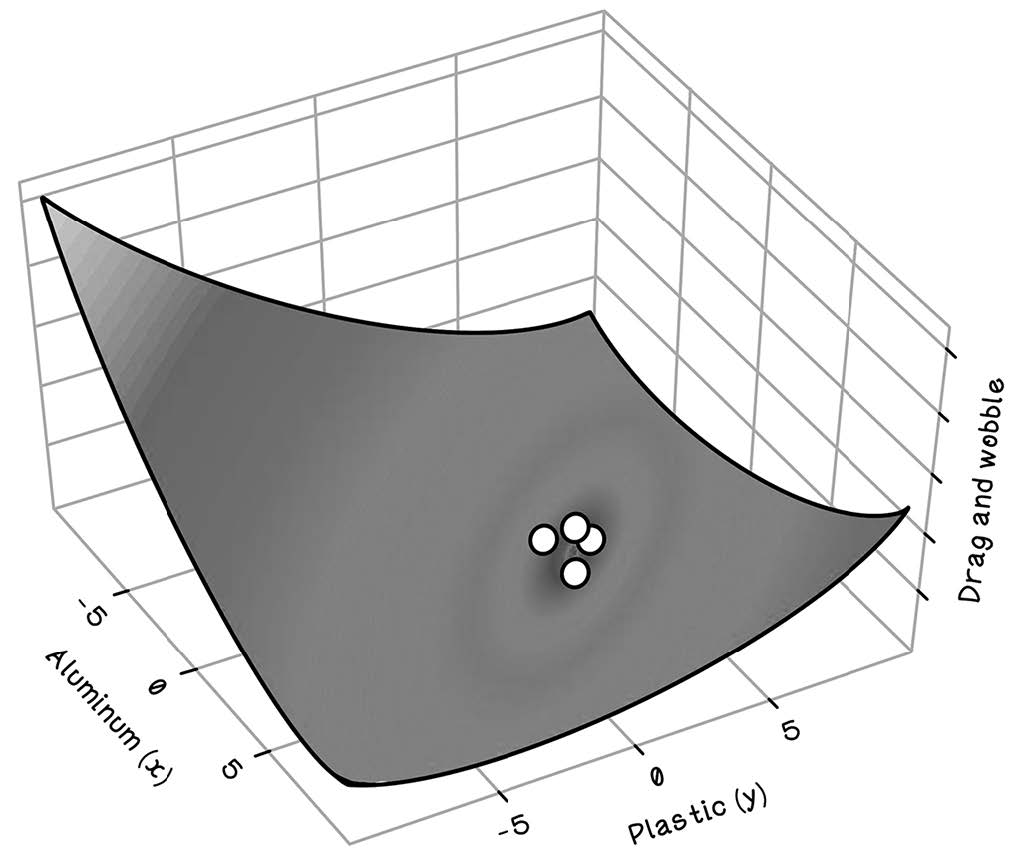
Use the visualization to see particles converge toward a known surface in the search space. section 7.8



