A user starts scheduling an appointment, then disconnects before it is booked. That is conversation abandonment: the interaction ends before the user’s task is complete. A disconnect alone is not enough to identify it; users also leave after getting what they need. section 3.3.2
Look at what happened before the exit
If the user disconnects midway through appointment scheduling, classify the unfinished interaction as abandonment. If the bot has already answered the question and the user leaves, the interaction may be an automated resolution instead. A user who asks for an agent after a misunderstanding belongs in an escalation category, not abandonment. These distinctions reveal more than a simple count of conversations that stayed with the bot. section 3.3.2
To investigate abandonment:
- Review transcripts to find the last step reached and what the user said before disconnecting. Do not rely on a complaint: frustrated users may leave without one. section 3.3.2
- Compare the time spent at each step, including average and maximum times. Long delays may point to a slow backend response or a confusing question; inspect the conversation before deciding which. section 3.4.1
Figure 3.13 When the outcome model and conversation design are overlaid, insights become apparent. This chart breaks down failed conversations by the last step before failure, helping identify where users struggle most. The different categories—such as appointment scheduling, intent detection, and zip code entry—show their relative contributions to overall failures over time. The spike after “Changes deployed” highlights the effect of recent updates, offering insights into areas needing further optimization.
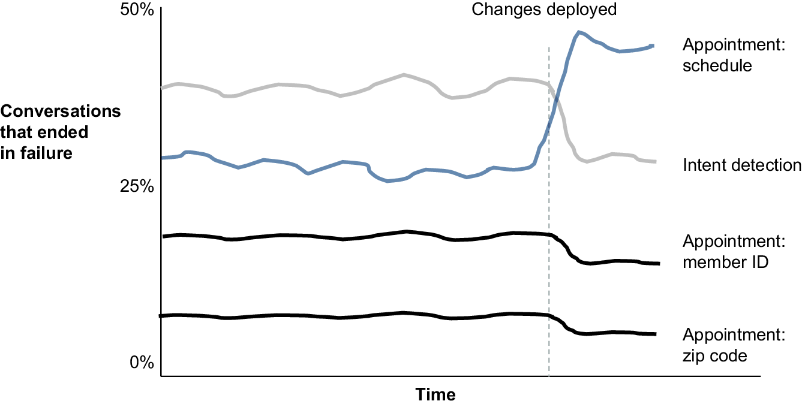
Breaking failed conversations down by their last step helps locate where users struggle and shows how that pattern changes over time. section 3.3.2
Treat abandonment as a signal to investigate, not proof of a single cause. Classify the outcome, locate the point of exit, and examine the surrounding exchange and timing before changing the flow. section 3.3.2 section 3.4.1
