Convexity is a property of functions, sets, and optimization problems. It is valuable because convex problems can be solved efficiently, and a solution found is guaranteed to be globally optimal. Without convexity, a solver may stop at a local minimum or miss a better solution. section 10.1.2
Recognize convexity through two line-segment tests:
- A function is convex when, for points x and y and 0 ≤ λ ≤ 1, f(λx + (1 − λ)y) ≤ λf(x) + (1 − λ)f(y). The graph stays below the line joining the endpoint values. section 10.1.2
- A set is convex when every point on the line segment between any two points in the set also remains in the set; practically, it has no holes. section 10.1.2
Why portfolio constraints matter
A nonconvex objective can have multiple local minima, so initialization may determine which solution an algorithm finds. In portfolio optimization, adding constraints can reduce the concentrated or unintuitive portfolios produced by naive unconstrained optimization. section 10.4
Figure 10.4 A convex function
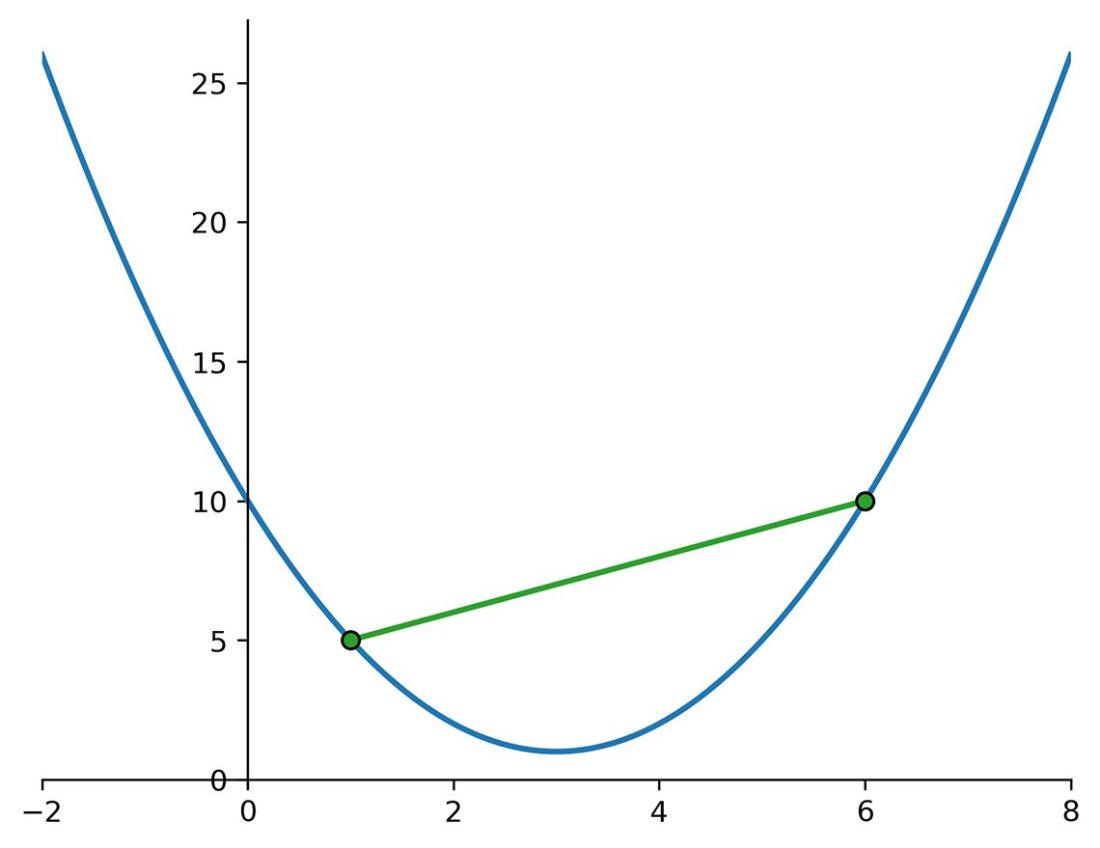
Visualizes a convex function whose values along a segment remain below the line connecting the endpoint values. section 10.1.2

