A convolutional autoencoder learns to reconstruct structured inputs, especially images, without labels. It combines convolutional feature extraction with an encoder–decoder design: the encoder compresses an image into a narrow latent representation, and the decoder rebuilds the image from that representation. section 8.0 section 8.1.1
Training repeatedly compares each input with its reconstruction, commonly using mean squared error or pixel-wise loss. Convolutional and MaxPool layers progressively extract and aggregate image features; UpSampling layers expand the latent view back toward the original dimensions. section 8.1.1 section 8.1.2
A compact Keras architecture follows this sequence:
- Accept a 28×28 single-channel image. section 8.1.2
- Encode it with convolutional layers using 64, 32, and 16 filters, placing 2×2 MaxPool layers after each convolution. section 8.1.2
- Decode the latent view with convolutional layers and three 2×2 UpSampling operations. section 8.1.2
- End with a one-channel convolution, combine the input and output into a Keras model, and compile it with Adam and MSE. section 8.1.2
Visualizing learned representations
After training on handwritten digits, project the latent encodings into two dimensions with t-SNE. Clustering by digit class makes the feature representation visible even though the autoencoder received no labels. section 8.1.1
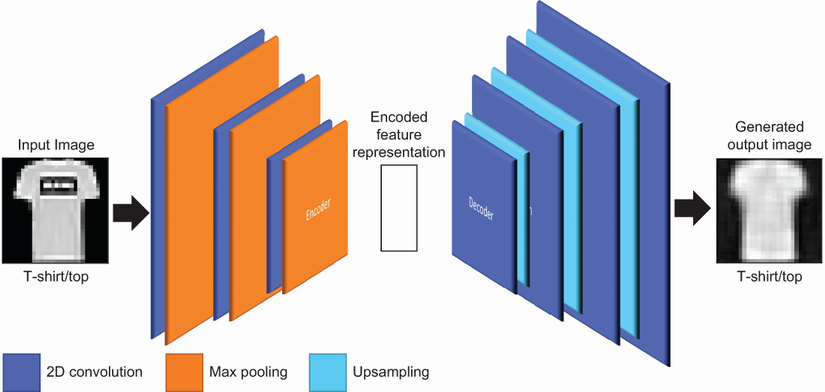
Use the architecture figure to inspect the encoder, latent view, decoder, convolutional layers, pooling, and UpSampling flow. section 8.1.1