Conway's law states that organizations tend to produce system designs that copy their communication structures. Architecture therefore reflects team boundaries, collaboration patterns, and organizational priorities. Ignoring this relationship can produce tightly coupled software, cross-team dependencies, siloed data, and fragmented user experiences. A socio-technical approach jointly optimizes organization design and software architecture. section 2.2.1 section 11.1.6
Apply Conway's law as a diagnostic and design principle:
- Circulate the principle widely before modernization and find examples in existing team structures, collaboration patterns, and architecture. section 2.2.1
- Align teams, domain boundaries, and codebases so that a team can change concepts within one business subdomain without coordinating with other teams. section 2.2.2
- Use collaborative domain modeling to combine perspectives rather than allowing isolated architecture decisions to harden mismatched boundaries. section 2.2.2
- Treat organizational and architectural changes as mutually constraining, and manage team cognitive load when defining responsibilities and interactions. section 11.1.6 section 11.6
Silos reflected in architecture
A siloed organization gave teams separate objectives and encouraged independent work. Changes by one team consequently broke other teams, data remained siloed, and users experienced a fragmented product. The architecture reproduced the organization's communication structure. section 2.2.1
Figure 2.1 Fast flow requires loosely coupled software architecture, which requires loosely coupled domains.
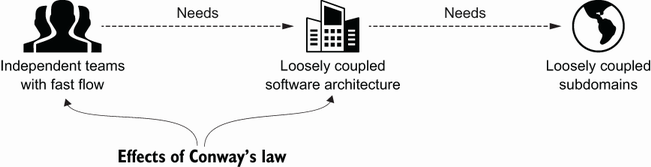
The figure connects fast flow to loosely coupled software architecture and, in turn, to loosely coupled domain boundaries. section 2.2.2
