Cooling rate controls how quickly temperature decreases during simulated annealing. It is part of the annealing schedule, alongside starting temperature, iterations at each temperature, and final temperature. section 5.2.4
Cooling rate shapes the balance between exploration and exploitation:
- Cooling too quickly can prevent the system from reaching an ordered, low-energy state; in optimization, it can limit search quality. section 5.2.1
- Cooling gradually helps simulated annealing avoid suboptimal local minima while moving from broad exploration toward focused search. section 5.2.1
- Common schedules include linear cooling, where temperature decreases by a fixed pattern over pseudo-time; the schedule remains tunable. section 5.2.4
A practical starting-temperature heuristic
When objective-function changes are unknown, begin at a very high temperature, reduce it quickly until roughly 50%–60% of inferior moves are accepted, then use that temperature for slower cooling. section 5.2.4
Figure 5.8 Different SA cooling schedules
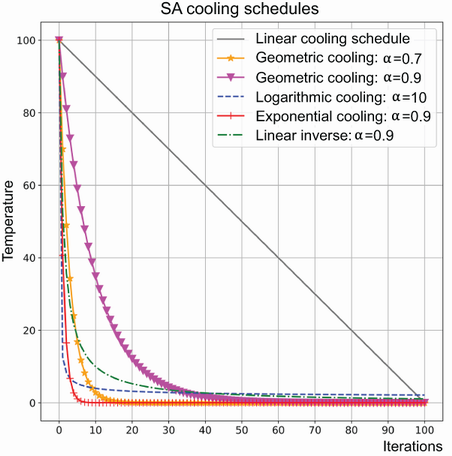
Compare how different cooling schedules decrease temperature over the annealing process. section 5.2.4
