A transaction coordinator (TC) receives requests from clients or proposers, assigns them an order or shared decision, and distributes that order or decision to participating components. It turns independently arriving requests into coordinated behavior. section 2.2 section 6.3.1
A useful mental model is a numbered dispatcher. The coordinator tags requests in arrival order, while recipients track the latest applied tag and wait for missing requests. In distributed transactions, it instead gathers participants’ votes and announces one shared commit-or-abort decision. section 2.2 section 6.3.1
In two-phase commit, the coordinator proceeds as follows:
- Prepare: persistently records Prepare and asks every resource manager whether it can commit. section 6.3.1
- Decide: commits only after every resource manager votes to commit; otherwise, an abort vote or timeout selects abort. section 6.3.1
- Distribute: persistently records the decision and sends Commit or Abort to all participating resource managers. section 6.3.1
Ordering conflicting requests
Two proposers issue +2 and ×2. Even if the network delivers ×2 first, the coordinator can tag it 0 and +2 1. Acceptors then apply the requests in tag order rather than network-delivery order. The same coordination role has a sharper failure cost in two-phase commit: if the coordinator fails after participants vote to commit, those participants may remain blocked until it recovers. section 2.2 section 6.3.2
Figure 2.12 Proposers, acceptors, and a coordinator
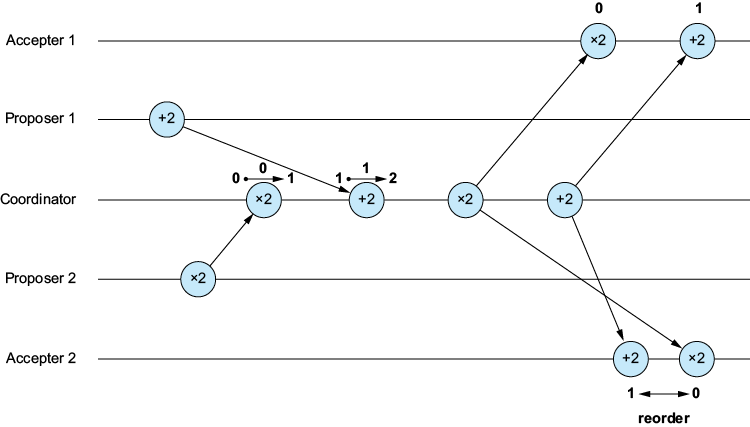
Shows proposers, the coordinator, and acceptors as a concrete request-ordering system. section 2.2

