A chatbot improvement can reduce user frustration yet demand substantial time, coordination, and technical complexity. Cost-benefit analysis compares those investments with expected direct and indirect gains. section 3.4.2 section 8.2.5
Assess a proposed change by considering:
- Benefits, including improved containment and user experience. section 3.4.2
- Costs, including implementation time, resources, complexity, and coordination across departments. section 3.4.2
- Expected return, scaled by the volume of affected conversations. section 3.4.2
- Operational risk, because added complexity creates more potential failure points. section 8.2.5
Simplifying an error-prone input
Suppose users must provide an alphanumeric membership number and frequently confuse letters with digits. A backend process can detect nine digits and add the shared alpha character, allowing a simpler question. Compare the implementation expense with reduced failures, lower user effort, and fewer agent handoffs; preserve retries, alternate paths, or escalation when the process fails. section 8.2.5
Figure 3.17 An effect-effort matrix visualizes the relationship between the effort required and the potential effect of a proposed change.
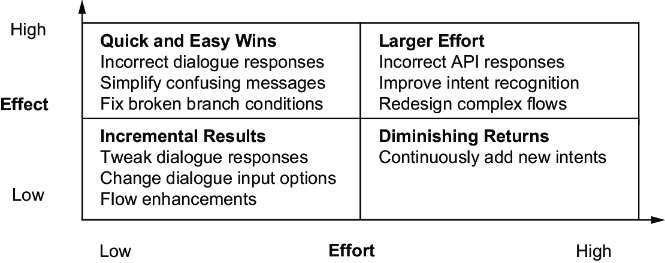
Use the effect-effort matrix to compare the potential effect of a proposed change with the effort required to implement it. section 3.4.2
