liveBook · Manning

Cost efficiency

As explained in Financial AI in Practice

The degree to which the value or benefit of a data source justifies its total acquisition and operating costs.

Cost efficiency asks whether a financial data source’s potential return from alpha justifies its total cost of ownership. That cost includes subscription fees and engineering work for cleaning, storage, and feature extraction. It is the final check in evaluating a data source’s business value. section 10.2.1

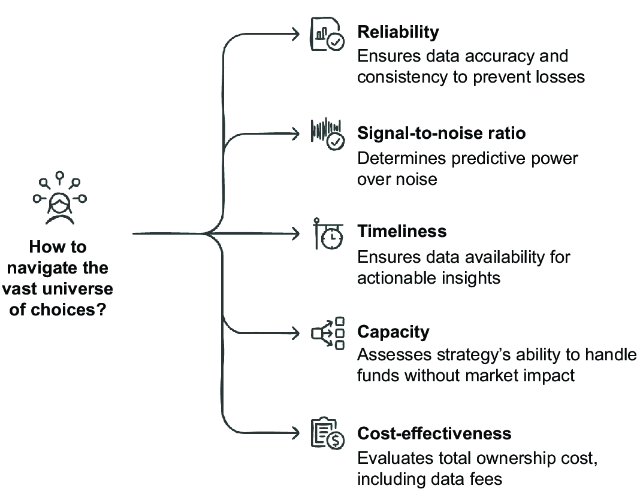
Figure 10.2 The professional quant’s framework for evaluating data sources is a five-point due diligence process to systematically filter potential alpha streams. In a world of infinite data, the ability to make intelligent choices is paramount. This framework isn’t merely a checklist but a rigorous gating process that professional funds use to assess the viability of any potential data source before committing significant time and resources.
figure

See how cost-effectiveness fits into a five-point due-diligence framework for screening potential data sources. section 10.2.1

How Financial AI in Practice covers it

How deep it goes
Defines total cost ownership components and links them to potential ROI, without specifying a calculation method.
Examples
Names subscription fees and engineering for cleaning, storage, and feature extraction as cost components.
What you can do after
Evaluate a financial data source by checking whether its potential alpha return justifies its total cost of ownership.
How it connects
Connects total cost of ownership and return on investment to alpha and financial data-source evaluation.

Related concepts

This explainer was generated by Manning's knowledge graph from the text of Financial AI in Practice. The section links point to the parts of the book it draws on.