A cost matrix lays out the cost of each possible worker–task pairing: rows represent workers, columns represent tasks, and each cell gives the cost of one assignment. The Hungarian algorithm uses this table to find a minimum-cost one-to-one matching. section 3.0
Figure 3.1 Cost matrix is created with the rows representing the workers and the columns representing the tasks. The values in the matrix denote the cost to complete the task. The cost can be replaced by other factors based on the use case like time taken, amount of work, or any other measurable value.
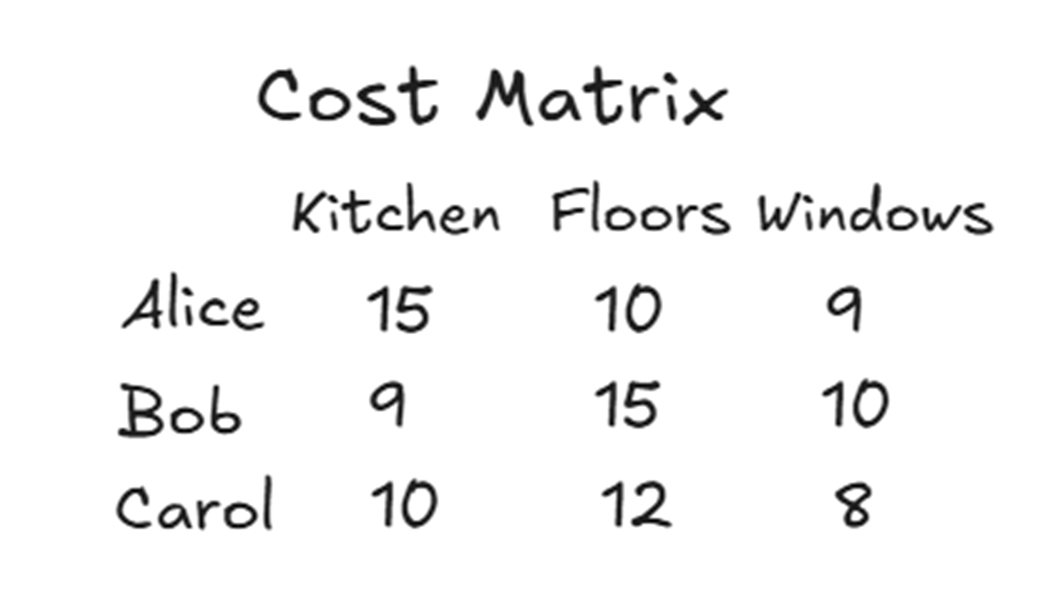
The figure shows how worker and task labels map to the rows and columns, and how each cell can hold a measurable assignment value. section 3.1
A small cost matrix makes the idea concrete:
- For three cleaners and three jobs, the entries are cleaning rates. The algorithm’s final pairings assign Alice to Floors, Bob to Kitchen, and Carol to Windows, for a total cost of 27 dollars. section 3.1
- The entries can also measure hours, such as the time developers need to complete software modules, or other measurable factors suited to the allocation problem. section 3.1
For the balanced case, the matrix is square, with the same number of workers and tasks. The Hungarian algorithm subtracts row and column minima to reveal zero-cost opportunities, then adjusts the matrix when those opportunities do not yet allow a complete assignment. section 3.4

