Cost of waiting is the worsening delivery, financial, operational, or strategic impact caused by delaying an architectural decision. It matters when postponement stops preserving flexibility and starts increasing exposure. section 4.4
Assess the decision alongside four competing forces:
- Cost of waiting: what worsens if the decision is delayed. section 4.4
- Cost of reversal: how expensive it would be to undo the decision later. section 4.4
- Remaining uncertainty: which important facts are unknown and whether they will soon become clearer. section 4.4
- Delivery risk: whether delay blocks progress, creates workarounds, or encourages unsafe shortcuts. section 4.4
Decision heuristic
Delay while uncertainty shrinks faster than risk grows. Decide when uncertainty stops shrinking, delivery risk rises, or reversal is about to become expensive. Preserve options with a seam, prototype, ADR, or compatibility strategy when commitment carries high reversal cost. section 4.4
Figure 4.2 Architectural decisions are most effective when made at the last responsible moment: late enough to preserve flexibility, but early enough to avoid delivery risk.
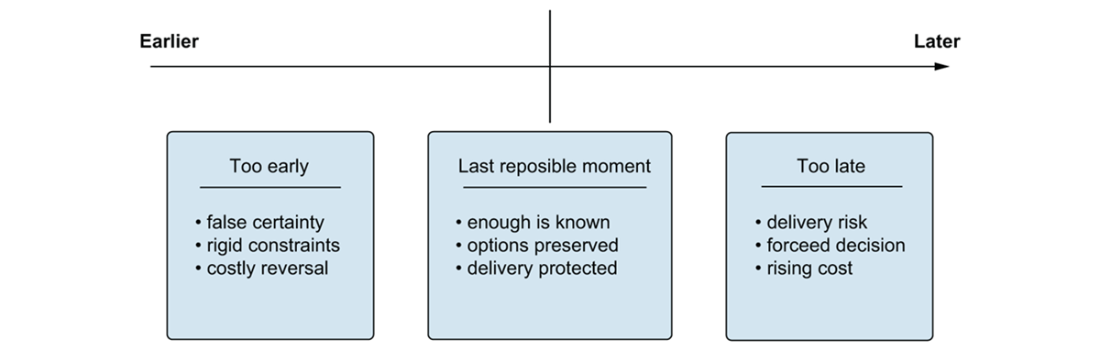
Visualizes the last responsible moment as the balance between preserving flexibility and avoiding delivery risk. section 4.4
