A counselor stance supports people who are struggling during collaborative modeling. It listens to their problems, helps them understand emotions and triggers, and recognizes when someone else should provide support. section 5.1.2
Use the stance to:
- Notice when personal difficulties or group dialogue become obstacles to participation. section 5.1.2
- Listen carefully and guide individuals toward clearer awareness of their emotions and triggers. section 5.1.2
- Respect the limits of facilitation and refer someone to a better-equipped person when necessary. section 5.1.2
- Combine compassion, observation, active listening, and holding space rather than treating counseling as a separate job title. section 5.9
Individual conversations at BigScreen
Before a collaborative modeling session, individual interviews with Rose and Jack examined the problems they were experiencing. The conversations used the counselor stance to listen, explore emotions and triggers, and determine what support might be appropriate. section 5.1.2
Figure 5.1 The facilitator takes on different stances. The observer stance takes a central place, which provides a facilitator with important information to take on other stances.
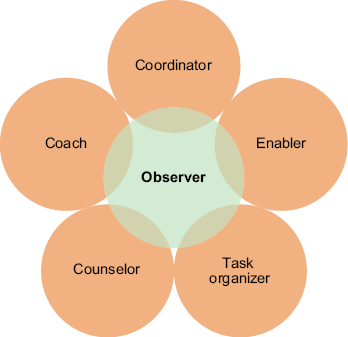
The facilitator’s stances are interconnected: observation supplies information for choosing when to act as a counselor, coach, enabler, or coordinator. section 5.1
