liveBook · Manning

Count pattern

As explained in Event Processing in Action

An event pattern that detects when the number of qualifying events reaches a specified threshold.

A count pattern counts participant event instances and compares the total with a fixed threshold using a relation such as ≥ or =. A match includes the entire participant event set, even when it contains multiple events of the same type. section 9.2.2

Customer complaints

A pattern can match when a customer makes at least three complaints in one working day. If the match is checked whenever an event arrives, it may be detected at 14:10; checking only after the context window closes delays detection until the end of the day. section 9.2.2

Figure 9.4. A count pattern where three instances of the same event type—customer complaint—match the pattern and suggest the likelihood of a frustrated customer
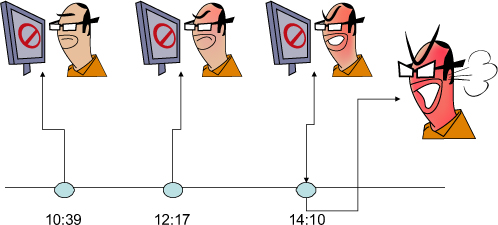
The figure shows three complaint events of the same type forming a count-pattern match. section 9.2.2
How Event Processing in Action covers it

How deep it goes
Defines count assertions, matching sets, and early detection, but stops short of implementation steps.
Examples
Uses three daily customer complaints and a sixth event satisfying a >5 threshold.
What you can do after
Evaluate whether an event set meets a count assertion, including whether detection can precede collection completion.
How it connects
Connects count patterns to threshold patterns, participant event sets, and pattern detection.

Related concepts

This explainer was generated by Manning's knowledge graph from the text of Event Processing in Action. The section links point to the parts of the book it draws on.