liveBook · Manning

Counter-positioning

As explained in Crack Any Codebase with AI

Counter-positioning is a competitive strategy in which a company adopts an approach that an incumbent cannot readily copy without damaging its existing business.

Counter-positioning is a competitive strategy: refuse an incumbent's profitable behavior so you can go deeper in a different direction. The move works when copying you would damage the rival's existing growth engine or business model. section 5.4

Cal.com versus Calendly

Cal.com gives up Calendly's consumer brand, viral footer, and referral loop. In exchange, it emphasizes white-label embedding, developer features, a platform API, and OAuth. Removing Calendly's branding would weaken its acquisition channel, while Cal.com can trade exposure for deeper integration into customers' products. AGPLv3 reinforces the position by pushing commercial users with private modifications toward a paid license. section 5.4 section 5.6

Figure 5.6 Cal.com and Calendly as two icebergs, each with a different product strategy. Cal.com has a small visible tip (a booking link) supported by a large, deep base of developer features: an embed system, a platform API, white-label branding, and an OAuth layer. Calendly's iceberg is the reverse: a large, branded surface with a much smaller platform underneath.
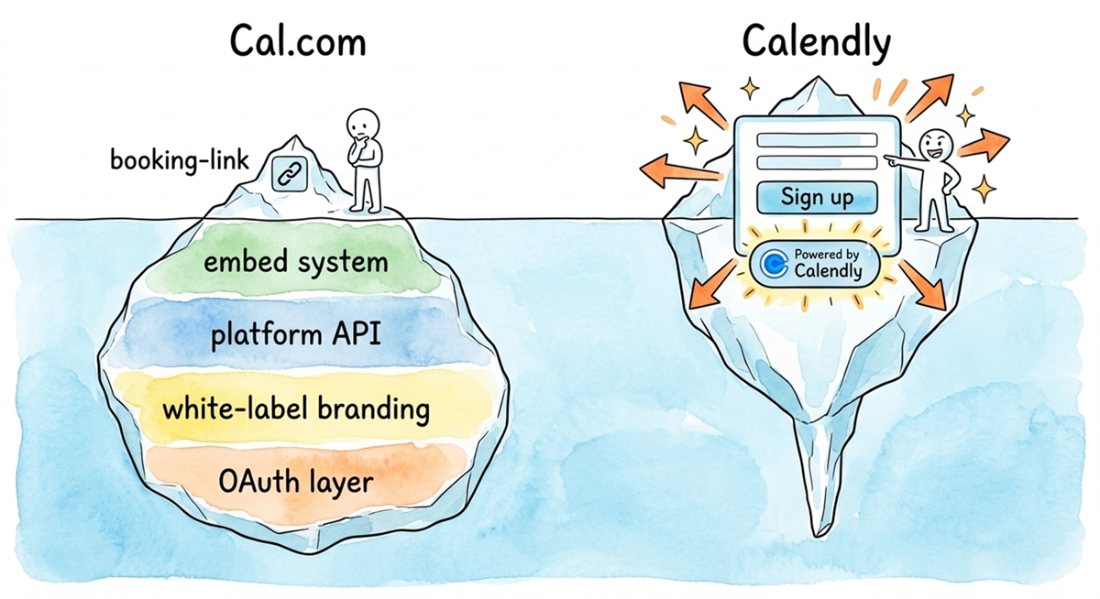
Use the iceberg comparison to distinguish visible product surfaces from the deeper capabilities that make a counter-positioning strategy defensible. section 5.4

How Crack Any Codebase with AI covers it

How deep it goes
Explains the mechanism through product trade-offs, competitive moats, licensing, and comparative examples, but does not provide a formal assessment procedure.
Examples
Uses Cal.com versus Calendly, Vue versus React, and AGPLv3, permissive, open-core, and source-available licensing models.
What it assumes
Assumes basic familiarity with products, competitors, business models, and software licensing while connecting implementation choices to strategy.
What you can do after
Evaluate product strategies by locating the incumbent behavior a rival cannot abandon and the deeper capability gained by rejecting it.
How it connects
Connects counter-positioning with switching costs, network effects, brand, open-source licensing, white-label branding, and platform APIs.

Related concepts

This explainer was generated by Manning's knowledge graph from the text of Crack Any Codebase with AI. The section links point to the parts of the book it draws on.