Counterfactual identification determines whether a target counterfactual quantity can be uniquely computed from available observational or interventional distributions plus causal assumptions. A causal DAG generally supports level 1 and level 2 reasoning but does not, by itself, identify level 3 counterfactuals; those require additional assumptions not representable in a simple graph. section 10.6
A structural causal model (SCM) can answer every counterfactual query defined on its variables, but only by encoding all required level 3 assumptions. Because several SCMs may agree on observational and interventional data while disagreeing about counterfactuals, identification targets one query with the smallest defensible set of extra assumptions. section 10.6 section 10.6.1
A Bayesian workflow handles residual uncertainty when general counterfactual identification lacks a universal algorithm:
- Specify diverse SCMs consistent with the causal assumptions. section 10.6.2
- Place priors over those models according to their plausibility. section 10.6.2
- Update the models with observational and interventional data. section 10.6.2
- Run counterfactual inference for the target query in each posterior-sampled SCM and inspect the resulting posterior distribution. section 10.6.2
Promotion and customer retention
Suppose a customer might be persuadable, meaning a promotion improves retention, or a sleeping dog, meaning the promotion reduces it. Assuming monotonicity rules out the sleeping-dog case, identifying that the promotion would help or at least not hurt this customer. section 10.6.2
Figure 10.13 Two different SCMs encode the exact same observational and interventional distributions, but given the same exogenous variable value, you can get two different values of the corresponding endogenous variable in each model.
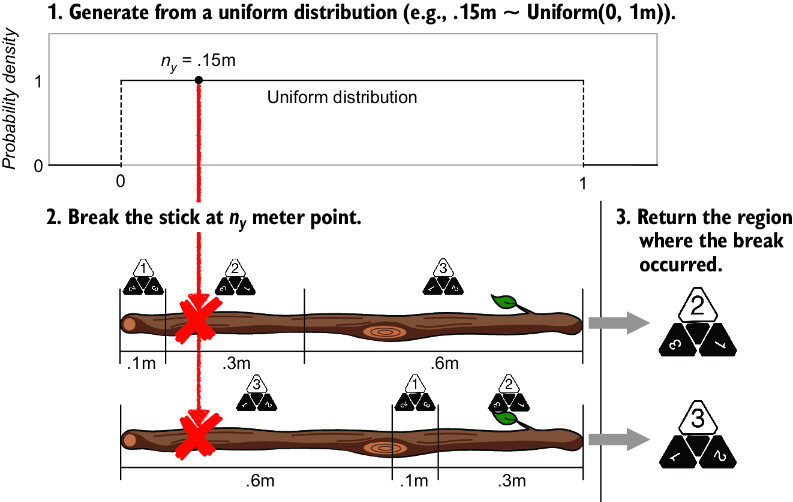
Compare two SCMs that match observational and interventional distributions yet produce different counterfactual outcomes for the same exogenous value. section 10.6.1
