CPU time here means task time (TT): the time spent actively working on a process task, including thinking, reading, and discussion. It excludes backlog waiting and interruptions. section 2.4
Use TT to track active effort at each process step. Unlike lead time (LT), it assumes needed information and dependencies are available and colleagues can work without interruption. section 2.4
When mapping a process:
- Record TT alongside LT and percentage complete and accurate (%CA) for each step. section 2.4.3
- Use a time ladder to show each step’s TT and LT and their totals, with TT above LT. section 2.4.3
API process mapping
For Acme’s API design and review process, record TT and LT at each step; Jira tickets indicate the number of work items awaiting processing. section 2.4 section 2.4.3
Figure 2.4 TT and LT for a step in the process
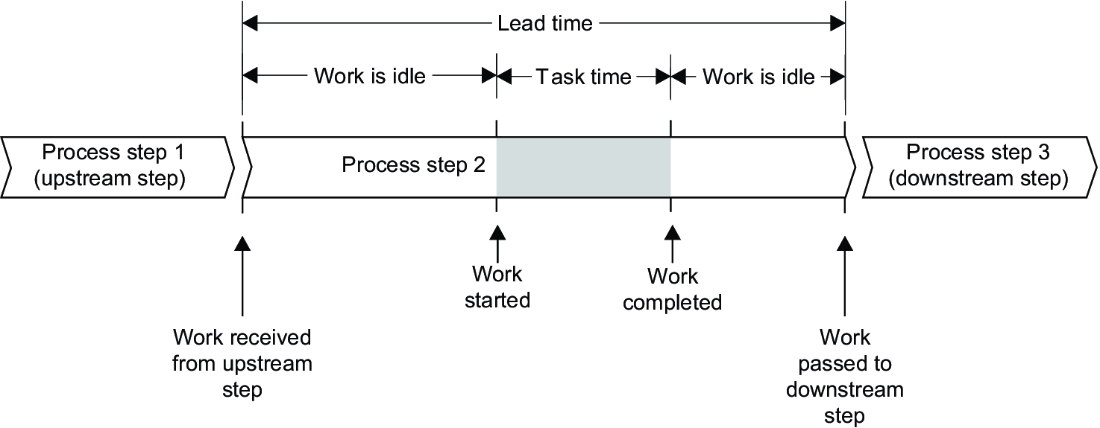
Compare TT with LT across one process step. section 2.4
Figure 2.7 Completed Current Conditions and Problem Statement section, showing the process map with metrics
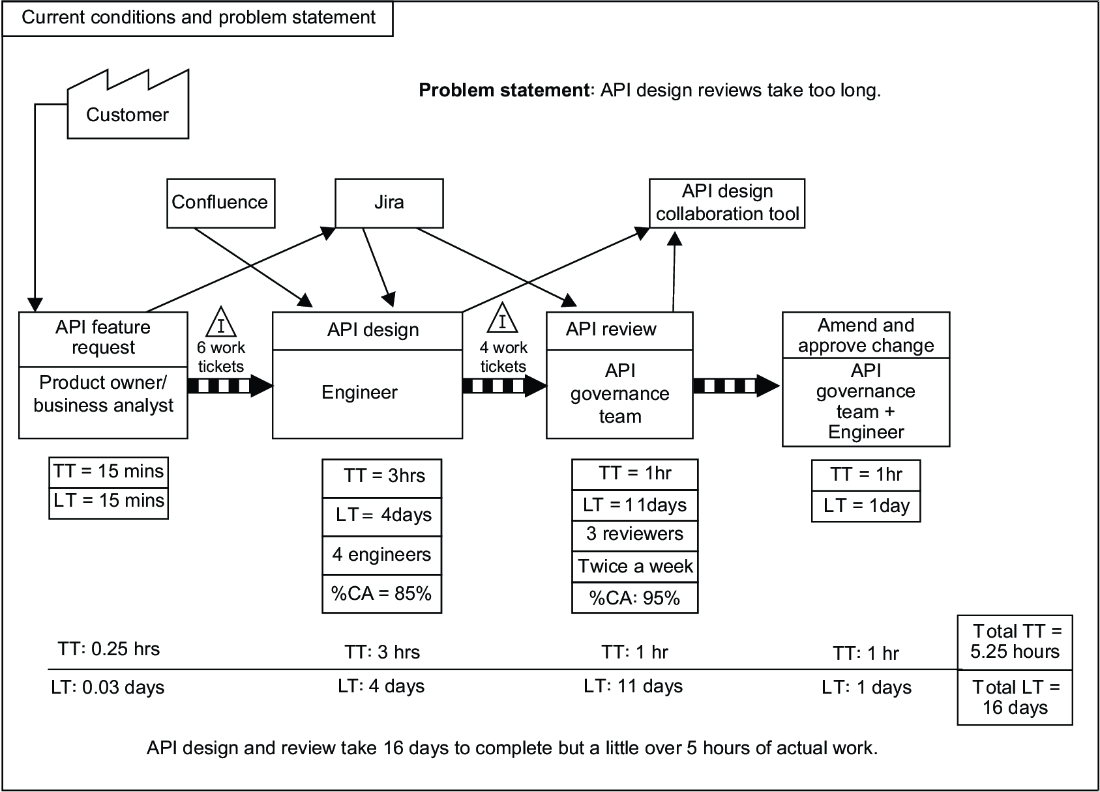
See TT and LT recorded on a completed process map. section 2.4.3



