Creative freedom is the latitude to choose among possible ideas, methods, or forms. In programming, it includes autonomy over how to approach an unfamiliar problem, not merely permission to write code at a desk. section 7.2.4 section 9.2.1
Freedom can look different at different stages of a programming career. Beginners often associate it with bootstrapping a greenfield project or working alone; experienced developers also associate it with thinking alongside others, comparing alternatives, and questioning the beaten track. section 9.2.1
Creative freedom becomes visible through ordinary working situations:
- Independence can support divergent thinking, especially when people are not constantly told what counts as being productive. section 7.2.4
- Useful ideas may appear away from the keyboard—in a gym, a car, or during a walk—even though implementation still requires programming tools. section 7.2.4
- Freedom does not mean unlimited choice: an amount of constraint can make creative work rewarding, while too much or too little freedom can create difficulty. section 4.5.2
The late lunch that looked unproductive
A team once played cards during a late lunch and appeared to be slacking. In reality, the break followed unusually hard and creative work. The episode raises a practical question: would forcing everyone back into a cubicle have protected productivity, or interrupted the conditions that helped ideas form? section 7.2.4
Figure 9.1 The academia-industry gap as illustrated by Adam Barr. University focuses on small programming problems, mostly at the individual level, while industry expects collaboration on big projects.
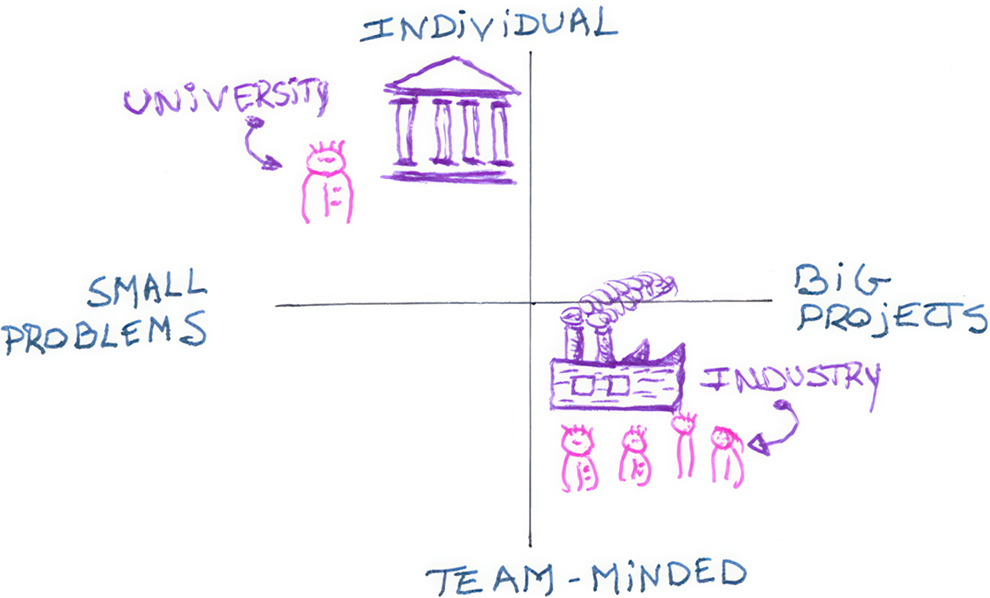
Compare the small, individual programming exercises common in university with the large, collaborative projects expected in industry. section 9.2.1
