A credential store is a protected repository that keeps secrets outside application code and supplies them to governed tool execution. Applications register a credential reference, while the Tool Service retrieves and injects the secret only when calling the external system. section 6.0 section 6.3.2
A production credential store separates secret management from application behavior:
- Provision credentials through an operations workflow; prompt for values securely instead of passing them as command-line arguments. section 6.3.2
- Reference credentials by name during tool registration, never by embedding their values in SDK calls or application code. section 6.3.2
- Inject secrets inside the Tool Service, keep them out of application-visible responses and logs, and sanitize external responses. section 6.3.2
- Apply rotation, expiration, and scope policies so operations teams can update credentials without deployments while limiting which tools may use them. section 6.3.2 section 10.6
Reference-based tool registration
A scheduling tool can declare credential_ref="scheduling-api-prod" while operations provisions that credential with a 90-day rotation policy and access limited to the healthcare.scheduling.* namespace. The next execution uses a rotated value automatically, without changing application code. section 6.3.2
Figure 6.6 Secure credential isolation and injection flow. When an application requests a tool execution, it passes only the operational arguments, remaining completely decoupled from the underlying authentication mechanisms. The Tool Service independently fetches the necessary API keys from the isolated Credential Store using the registered reference name. It then injects these secrets directly into the outbound HTTP request to the External API. Crucially, the external system's response is sanitized before being returned, ensuring that at no point do sensitive credentials traverse the application layer, appear in the Platform SDK, or leak into system logs..
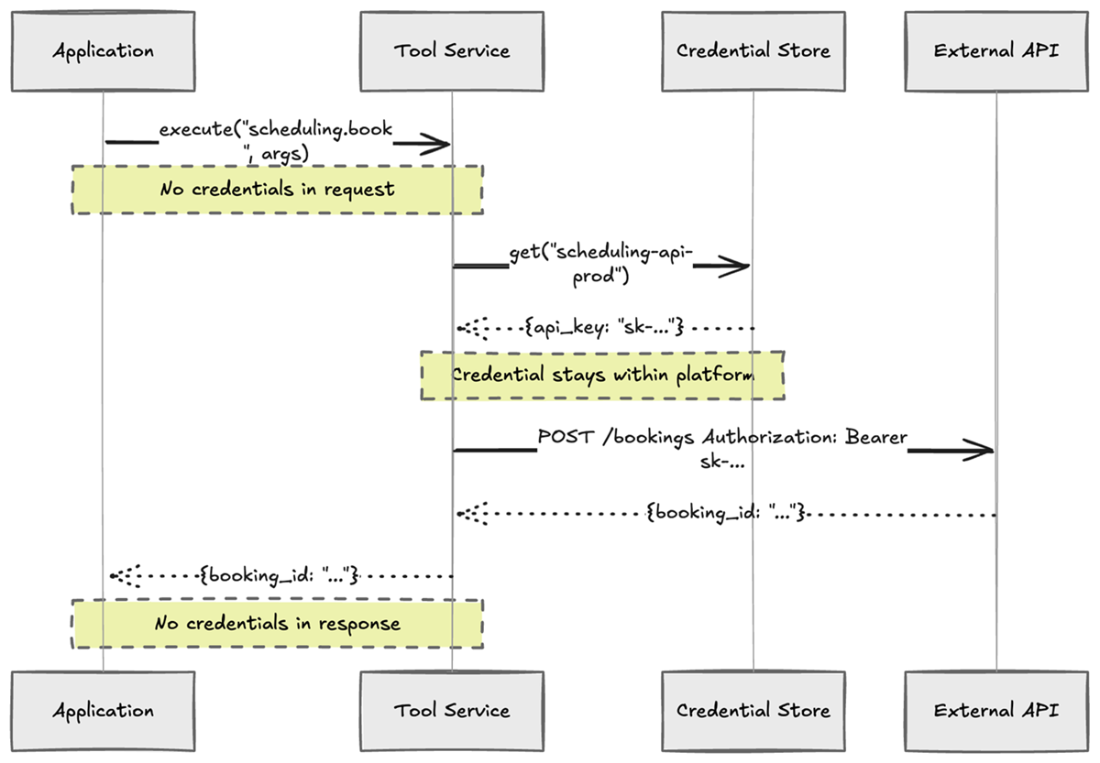
Trace the application-to-tool-to-external-API flow, including isolated retrieval, request injection, and sanitized responses. section 6.3.2


