The critical path is the minimum set of operations that must complete before a user can accomplish a goal or perceive an application as responsive. It is defined by what the user is waiting for, not by all work the system performs. Analytics, logging, cache warming, secondary fetching, and synchronization may be valuable, but they do not belong on the path when they do not block the immediate task. section 4.0 section 4.6
Treat every user goal as a separate path. On a product page, evaluating a purchase requires the product name, primary image, price, availability, page structure, and a working Add to Cart control. Reviews, recommendations, extra images, and analytics can arrive later. Loading them in the same blocking request makes users wait for work that does not help them decide or act. section 4.1
Locate a critical path by working backward from the user outcome:
- Name the goal for a screen or flow, such as completing checkout, viewing dashboard metrics, or sending a message. section 4.1
- List the minimum must-complete operations that let the user reach that goal. section 4.1
- Capture an operation timeline from user action until task completion with Browser DevTools, Android Profiler, Instruments, or Jaeger. section 4.1
- Draw dependencies as a graph: chained requests reveal blocking work, while sibling branches can run in parallel. section 4.4.3
- Move nonessential work behind asynchronous boundaries, background processing, lazy loading, or prefetching where correctness permits. section 4.3 section 4.6
Figure 4.1 Critical path and deferred work. The critical path blocks the user while deferred work happens afterward without affecting what they experience.
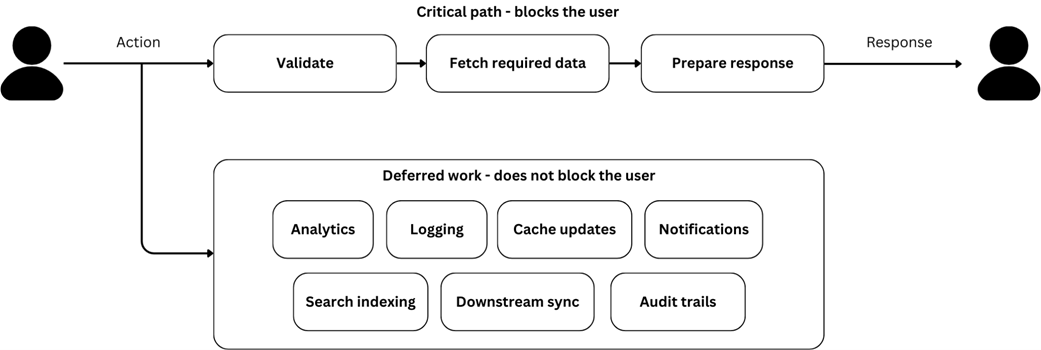
Use the diagram to separate operations that block a user from deferred operations that run afterward without changing the immediate experience. section 4.0
A short critical path is not always a short total process. For a web interaction, immediate acknowledgment can matter more than waiting for completion: optimistic updates show the expected result first and roll it back if the server fails. For form submission, validate input and show acceptance promptly while server processing, audit logs, indexing, and notifications continue asynchronously. section 4.2.1 section 4.2.1
Purchase confirmation without downstream blocking
A purchase must validate payment and confirm the order before success is shown. Inventory updates, warehouse notifications, emails, and analytics events can be placed on a message queue and processed afterward. This removes downstream acknowledgments from the user-facing path while allowing producers and consumers to operate independently. section 5.3.5
Platform details change what users wait for. Web paths prioritize visible feedback after an action. Mobile paths prioritize launch to a first useful screen and immediate touch acknowledgment; deferred code loading and cache pre-warming can reduce waits. Desktop applications should initiate long-running work, show progress, and keep the interface usable while lower-priority data loads progressively. section 4.2 section 4.2.3 section 4.2.4
Data fetching often lengthens a path accidentally. Independent calls should run in parallel rather than forming a waterfall through component or code structure. Batch related fetches where possible, and prefetch only high-probability next actions using signals such as link hover, scroll position, or usage patterns; incorrect predictions consume bandwidth. section 4.4 section 4.4.3
Do not defer work that establishes correctness or permission. Payment processing must finish before purchase confirmation, authentication before access, and file saving before success is reported. The operating principle is to make the required path as short as possible while aggressively moving secondary work out of it. section 4.3 section 4.6
Critical-path latency describes speed for one user completing one task. Measure it with task-relevant metrics such as Time to First Byte, Largest Contentful Paint, or p50 API response time, and distinguish it from scalability under load and resilience during failures; those problems need different remedies. section 5.1 section 5.1