A critical region is the part of concurrent execution that accesses a shared resource. If threads enter it without coordination, their operations can interfere and produce a race condition. Protect the region so that its shared resource remains consistent. section 16.2
Guard a critical region with synchronization that matches the access pattern:
- Use a mutex when only one thread may read or modify the resource at a time. Acquire it before entering and release it before leaving. section 16.2
- Use a semaphore when several readers may access a resource simultaneously, while writers must wait until readers finish. section 16.3.1
- Use a condition object when threads must wait for queue state, such as space becoming available or an empty queue becoming nonempty. section 16.4
- Release every mutex or semaphore before leaving the region; failing to do so can block other threads indefinitely and cause deadlock. section 16.6
Serializing a shared print stream
Three threads print different messages one character at a time. Without protection, thread scheduling and interrupted I/O intermix the characters, producing different malformed output on different runs. A Python threading.Lock fixes the design: each thread acquires the lock, prints its complete message, and releases the lock. The critical region is the inner printing loop. Writing `with printing_mutex:` expresses the same ownership boundary while ensuring the lock is released when the block ends. section 16.2.1
Reader-writer and producer-consumer regions
Technician threads update a shared meter, so only one technician may set it and no logger may read it during an update. Logger threads can read concurrently through a semaphore. In a bounded queue, producers wait while the queue is full and consumers wait while it is empty; each notifies waiting threads after changing that state. section 16.3.1 section 16.4.2
Figure 16.3 How a mutex guards a critical region. It allows only one thread at a time to be in its critical region.
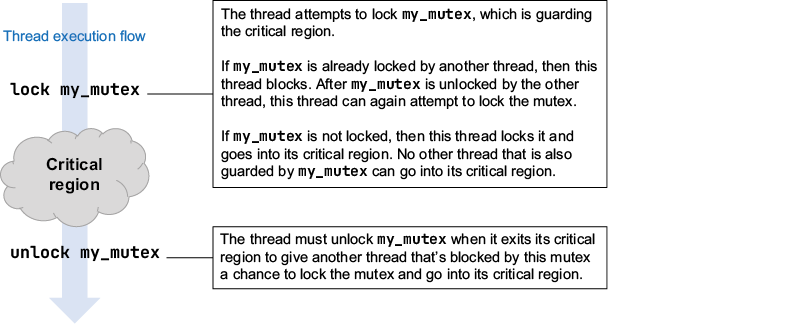
Shows how a mutex permits only one thread at a time to enter a critical region. section 16.2








