A cross-encoder scores the relationship between two inputs by processing them together. For semantic similarity, it concatenates a query and a document into one sequence, allowing the transformer to model fine-grained interactions between their tokens before producing a task score. This added interaction can improve comparison quality, but it requires more computation than encoding each input separately. section 4.0 section 4.3
Figure 4.3 An Overview of the Cross-Encoder Model to measure the similarity between two sentences.
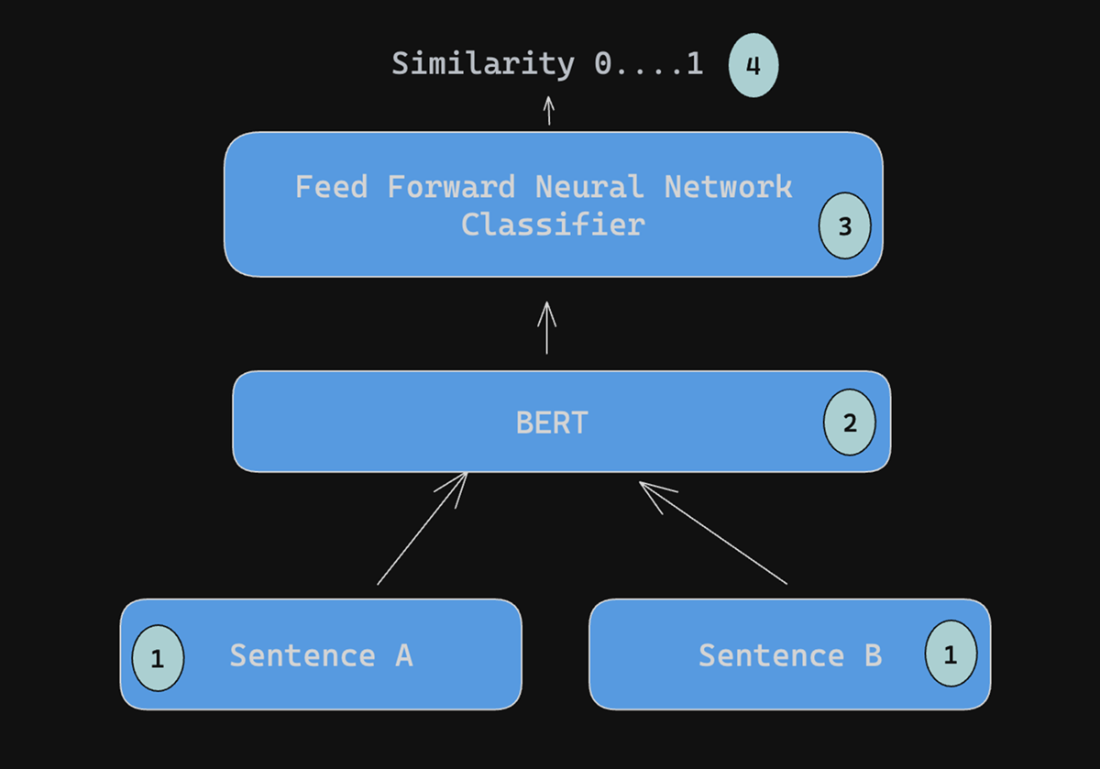
Use this architecture view to trace the paired sequence from two sentences through BERT to a similarity classifier. section 4.3
For a BERT-style similarity model, place Sentence A and Sentence B in the same input sequence with a [SEP] token between them. BERT produces contextualized token embeddings across the combined sequence; a feedforward classification layer then converts the model output into a similarity score, typically from 0 to 1. Unlike a distance calculation over independently stored vectors, this score is produced from the pair itself. section 4.3
Choose between paired scoring and independent encoding based on the search system's constraints:
- Use a cross-encoder when fine-grained query-document interaction is important and the extra computation is acceptable. section 4.0
- Use a bi-encoder when embeddings must be precomputed, stored, and searched efficiently for fast retrieval. section 4.6
- Do not expect a cross-encoder to yield standalone sentence embeddings for indexing; Sentence Transformers instead creates fixed-size sentence vectors for storage and comparison. section 4.2
Scoring a hotel request against a review
Pair the request “Hotel near the Louvre with great food nearby” with one hotel review. Feed the request and review together, separated by [SEP], through BERT and its classifier. The resulting score expresses the model's similarity judgment for that specific request-review pair. Repeating this operation for more reviews gives each candidate a direct paired score, at corresponding computational cost. section 4.3 section 4.0
Cross-encoders and bi-encoders therefore serve different parts of a semantic-search design. A bi-encoder supports vector-based retrieval through independently generated embeddings, distance metrics, and scalable indexes such as FAISS. A cross-encoder instead evaluates the interaction of a selected pair directly, trading efficiency for a more detailed comparison. section 4.0 section 4.6



