A crowdsourced worker completes tasks obtained through a crowd-based labor arrangement. In data annotation, workers typically choose jobs on an online marketplace for a posted price per task. They are often anonymous, with platforms enforcing anonymity through technical measures and terms of service. section 7.4
Pay-per-task annotation is also called microtasking and is considered part of the gig economy. Its main advantage is flexibility: a workforce can scale up or down quickly, including when thousands of people are each needed for only a few minutes. That flexibility also comes with vulnerability to exploitation. section 7.4
Crowdsourced workers can help with quick experiments to test whether a new annotation task can achieve a useful level of accuracy, or with annotations needed at short notice. Sustained projects more often use other workforces. Compared with contract and in-house workers, crowdsourced workers are easiest to scale but typically produce the lowest-quality annotations. section 7.4 section 7.1.1
Annotating financial news
A changing stream of news articles may call for crowdsourced workers to identify company names quickly. Contract workers can learn financial terminology for share-price judgments, while in-house experts handle difficult edge cases, resolve conflicting labels, and guide other workers. section 7.0
People who annotate data need fair pay, regular payment, and transparency about their work. Responsibility for their treatment remains with the people using the annotations, even when the work is arranged elsewhere. section 7.1.1 section 7.0
Figure 7.2 An overview of the three main types of workforces you can use to annotate data, in-house workers, contract workers, and crowdsourced workers, where the main trade-off is flexibility versus expertise.
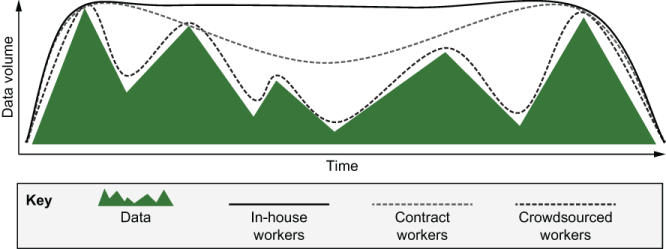
Compare crowdsourced, contract, and in-house workforces along the flexibility-versus-expertise tradeoff. section 7.1.1