liveBook · Manning

Cryptographic agility

As explained in Real-World Cryptography

Cryptographic agility is the ability of a protocol or standard to support changing among multiple cryptographic algorithms.

Imagine a protocol whose only algorithm is suddenly broken. Cryptographic agility lets clients and services switch among supported algorithms instead of becoming trapped by an inflexible design. section 16.2

Agility creates a tradeoff: supporting alternatives can ease migration when algorithms are deprecated, but excessive flexibility increases complexity and can enable downgrade attacks, as seen with TLS. section 16.2

Treat agility as a protocol-design decision:

  • Provide clear, safe interfaces and test vectors for each supported algorithm. section 16.2
  • Avoid letting negotiation complexity undermine security or preserve obsolete choices. section 16.2
  • Check threat models and composability before combining primitives or building a mini-protocol. section 16.2
Figure 16.1 The Tamarin protocol prover is a free formal verification tool that you can use to model a cryptographic protocol and find attacks on it.
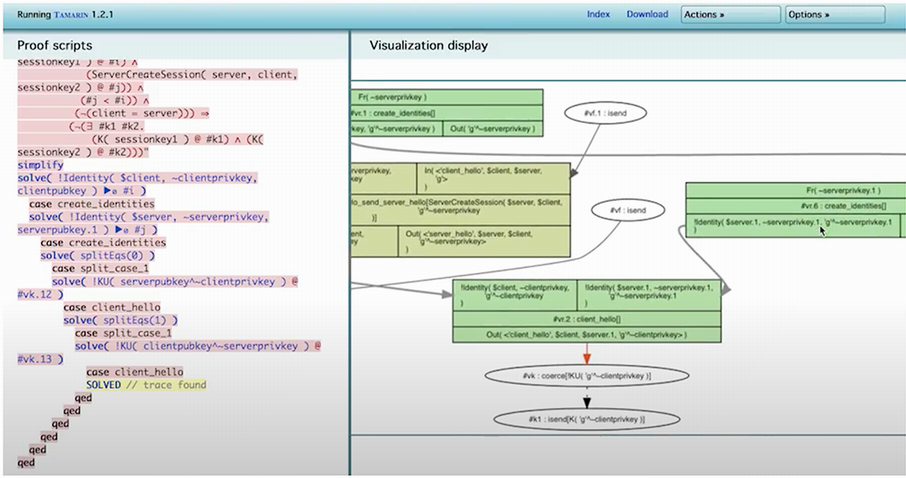
Model a cryptographic protocol and search for attacks with the Tamarin protocol prover. section 16.2

How Real-World Cryptography covers it

How deep it goes
Defines the tradeoff between migration flexibility and complexity, stopping short of implementation details.
Examples
Uses broken or deprecated algorithms, TLS downgrade attacks, test vectors, and Tamarin protocol modeling.
What it assumes
Assumes basic awareness of cryptographic algorithms, protocol composition, and threat models.
What you can do after
Evaluate protocol agility by weighing algorithm migration benefits against negotiation complexity and downgrade risk.
How it connects
Connects cryptographic algorithms, standards, TLS, downgrade attacks, threat models, composability, and formal verification.

Related concepts

This explainer was generated by Manning's knowledge graph from the text of Real-World Cryptography. The section links point to the parts of the book it draws on.