Cryptography uses mathematical algorithms and their software or hardware implementations to protect data. Its core security goals are confidentiality, integrity, and authenticity: keep data from unauthorized disclosure, prevent alteration, and prevent impersonation of digital entities. Encryption makes a message incomprehensible without the corresponding secret; integrity and authenticity extend protection beyond secrecy. section 1.1 section 1.5
Figure 1.1 Security goals of cryptography
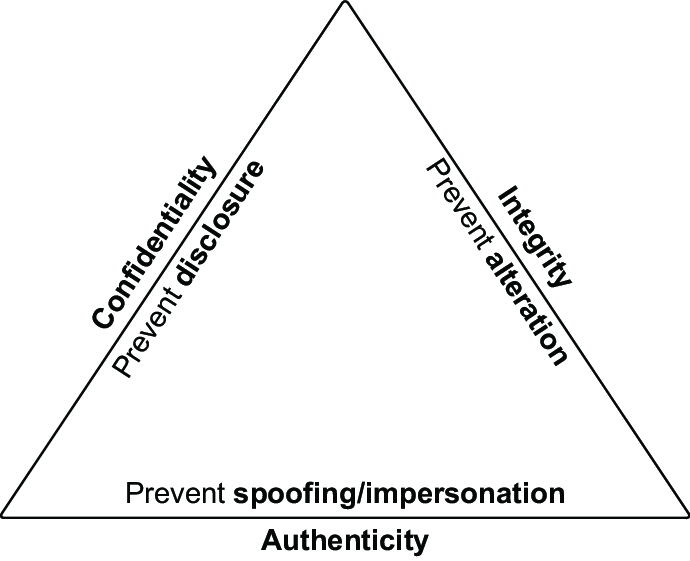
The three security goals provide a practical way to judge what protection a cryptographic component is meant to deliver. section 1.1
A lockbox illustrates confidentiality: a sender can ship a locked box through ordinary mail, while carriers can see its destination but not its contents. Similarly, internet packets may traverse providers while cryptography protects message contents from eavesdroppers. Modern cryptographic tools also protect against tampering and establish authenticity. section 1.1
Cryptographic engineering separates sound goals from risky implementation details:
- Mathematical cryptographic ideas can be difficult to break, but programming and hardware flaws often give attackers easier paths around them. section 1.0 section 1.3
- Subtle defects can defeat an entire system security goal; side-channel analysis of device power consumption can expose a cryptographic key. section 1.3
- Production systems should rely on widely used, thoroughly tested implementations rather than homegrown cryptography; even established components can interact in weak ways. section 1.4 section 1.5
Encryption keys: symmetric and asymmetric
Symmetric encryption uses the same private key to encrypt and decrypt. Stream and block ciphers reduce the secret material needed compared with a one-time pad, but participants still need a way to exchange the shared key securely. Asymmetric cryptography addresses that distribution problem with a keypair: a public key may be shared openly, while its corresponding private key remains secret. Symmetric keys can also be wrapped with asymmetric keys. section 8.1 section 8.1
Implementation failure: PlayStation 3
A cryptographic implementation can fail even when the protected private key never appears on consumer hardware. Improper random-number generation in a critical operation allowed Sony’s private key to be calculated and published, undermining the console’s software-approval security goal. section 1.3
Use cryptography as an engineering discipline, not merely a collection of algorithms. Run implementations and exploits when learning, treat precision as a security requirement, and seek broad expert review when cryptographic code must be written from scratch. section 1.4 section 1.5



