liveBook · Manning

Curing

As explained in Data-Oriented Programming in Java

Curing is the chemical hardening process by which a drying oil becomes a protective film over time.

Curing is the chemical hardening process in which a drying oil reacts with oxygen and becomes a protective film over wood. Because the reaction is invisible, progress is inferred from changing water resistance. section 3.1

Curing is evaluated through surface measurements:

  • Place a water droplet on the finished wood and measure its contact angle. section 3.1
  • Interpret a larger contact angle as greater curing. section 3.1
  • Treat the finish as sufficiently cured when the contact angle stops changing from day to day. section 3.1

A curing measurement

A measurement can record sampleId "UV-1", day 3, and contactAngle 17.4. Such data can be translated into Java, but the fields still require domain interpretation. section 3.1

Figure 3.1 The basics of drying oils
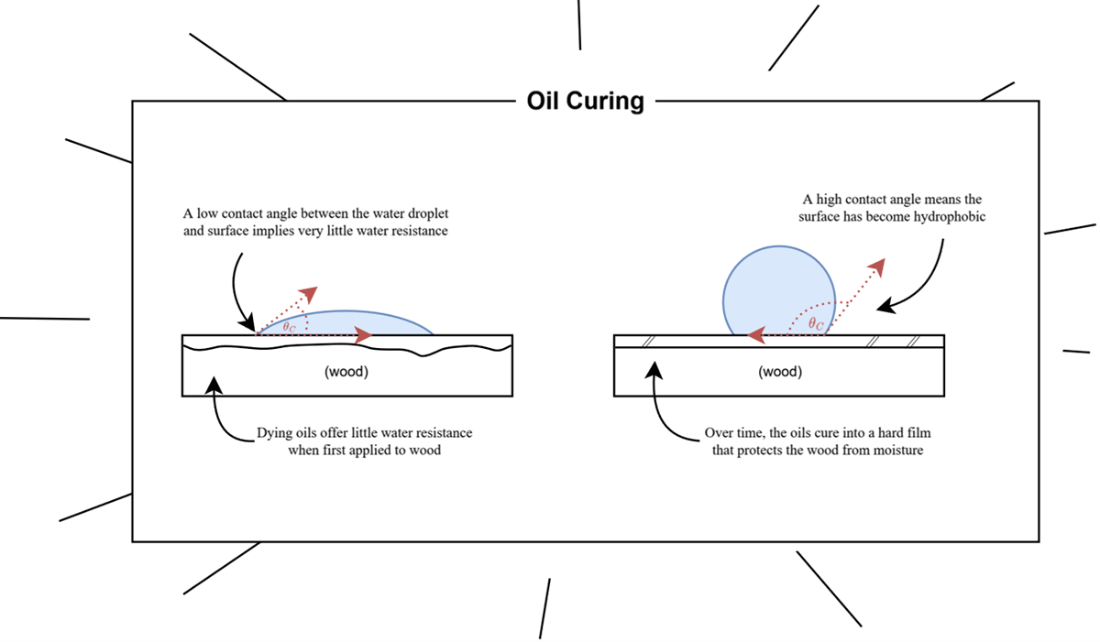
Use the figure to orient the relationship between drying oil, oxygen, hardening, and wood protection. section 3.1

How Data-Oriented Programming in Java covers it

How deep it goes
Explains the chemical process and measurement-based endpoint, then begins examining the meanings of recorded fields.
Examples
Uses Tung oil measurements, water droplets, JSON records, and Java record modeling.
What you can do after
Evaluate/understand curing through contact-angle measurements and question mechanically translated Java data models.
How it connects
Connects drying oils with oxygen, protective films, water resistance, and contact angle.

This explainer was generated by Manning's knowledge graph from the text of Data-Oriented Programming in Java. The section links point to the parts of the book it draws on.