Curve continuity asks how neighboring curve pieces meet. If their endpoints do not coincide, a gap makes them discontinuous. If they meet but their slopes change, the join forms a corner. A smooth join has no change in slope. section 2.2
Joining Bézier curves
For two adjacent Bézier curves, place the control points attached to the shared endpoint in a straight line, 180° apart. The curves then join smoothly; otherwise, the join has a definite corner. This matters when assembling the curves that form an ampersand. section 2.2
Figure 2.7 Discontinuous (upper), continuous (lower left), and smooth continuous (lower right) pairs of Bézier curves. Notice the control points in the smooth continuous case are at 180° to one another.
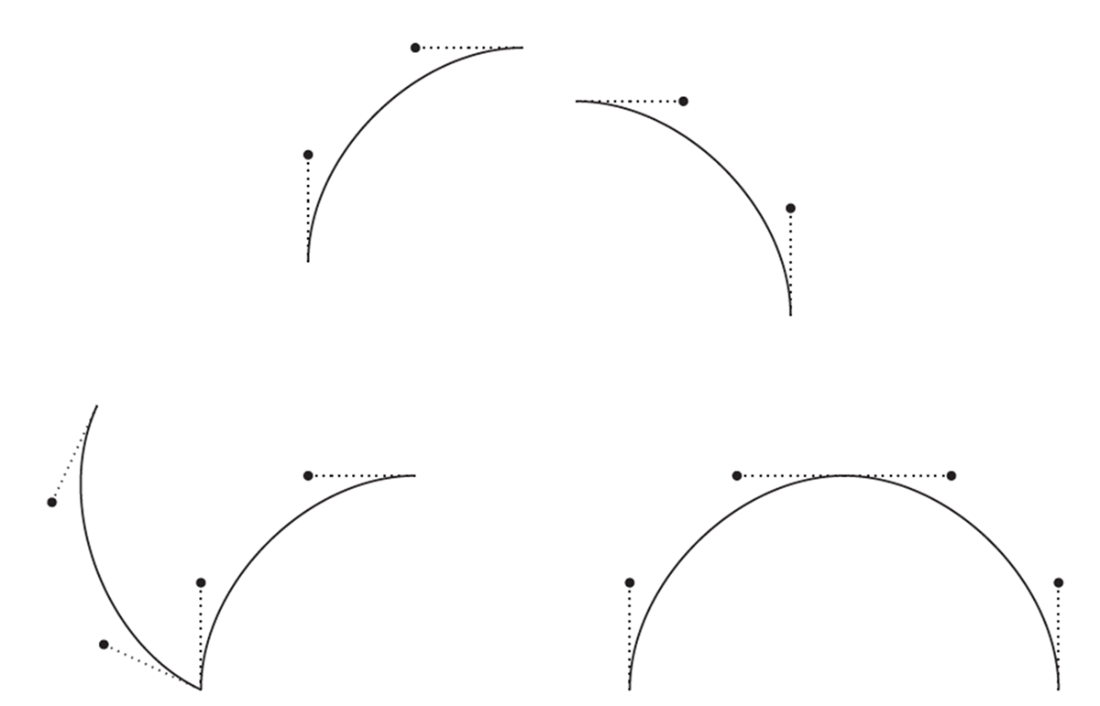
Compare discontinuous, continuous, and smooth continuous Bézier-curve pairs, including the control-point arrangement that produces a smooth join. section 2.2