Custom data gives a language-model application the domain knowledge, user context, and current information that generic outputs often miss. It may appear as few-shot examples, a retrieval database, or fine-tuning data, and it must remain representative and up to date. section 5.4.5 section 7.0
A marketing assistant with proprietary knowledge
A B2B SaaS marketing team finds that generated content lacks specificity because relevant insights are scattered across Confluence, Salesforce, Google Drive, and other internal sources. Retrieval-augmented generation can retrieve that information at response time, avoiding constant retraining while keeping content aligned with the company’s audience and expertise. section 7.1.2
Treat custom data as an operating practice rather than a one-time upload:
- Review model failures and add correcting examples to the dataset. section 5.4.5
- Monitor whether data still represents changing trends, users, and expectations. section 5.4.5
- Automate data monitoring, error tracking, evaluation, and updates where practical. section 5.4.5
Figure 7.1 From semantic search to a full RAG system
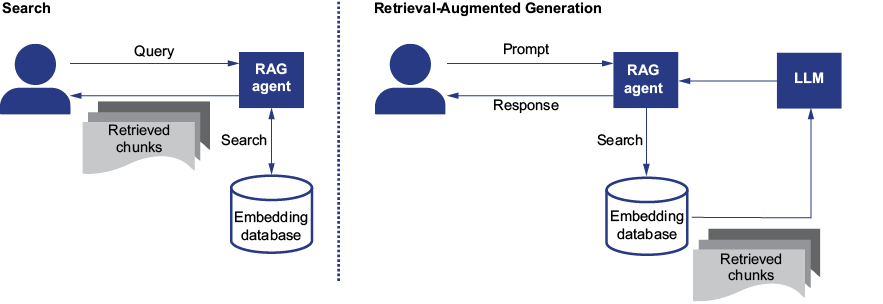
Use the progression from semantic search to a full RAG system to connect custom knowledge with generated responses. section 7.0
