The cybersecurity budget ratio measures cybersecurity spending as a percentage of the total information-technology budget. It keeps security investment visible in financial planning and supports data-driven discussions about preparedness, priorities, and future threats. section 5.2.3
Use the ratio to:
- Compare cybersecurity investment with industry expectations; the observed range is 1% to 25%, while projected AI-related pressures could raise a future norm to 35%. section 5.2.3
- Connect spending decisions with cybersecurity awareness, threat detection, incident response, and the changing balance between AI-enabled attacks and defenses. section 5.2.3
- Interpret budget changes alongside behavioral evidence, such as phishing reports, policy violations, and post-training assessment results. section 5.2.4
TechGuard Solutions dashboard
TechGuard Solutions begins with cybersecurity receiving 25% of its total IT budget and establishes a target of 40%. The dashboard pairs this financial measure with awareness training, which rises from 75% to 100% completion. The ratio is most useful when leadership reviews it with evidence that investment changes security behavior and preparedness. section 5.2.4
Figure 5.4 The left side shows TechGuard Solutions’ organizational metrics dashboard before the focus on training and budget increases. Testing percentages show the overall pass rate from testing. The cybersecurity budget is the total cyber budget as a percentage of the total IT budget. Cybersecurity budgets are most often a percentage of the overall IT budget. The right side shows the organizational metrics dashboard after 3 years and the implementation of strategic training program improvements.
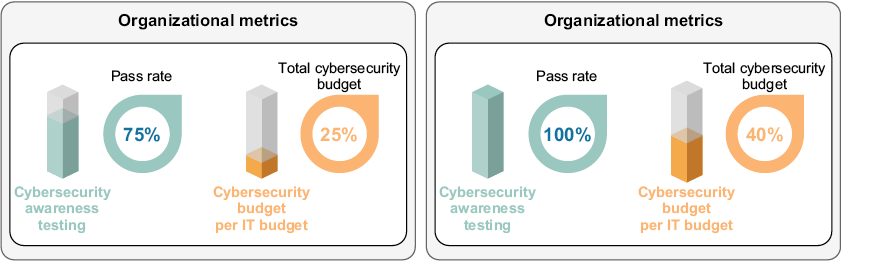
Compare the organizational metrics dashboard before and after strategic training and budget increases, including the cybersecurity budget as a percentage of total IT spending. section 5.2.4
