A cyclic group is a group generated by one element: every element is an integer multiple or power of that generator. In elliptic-curve mathematics, points may form one cyclic group or a product of two cyclic groups. section 2.2 section 15.1
The order of a group is its number of points. If a curve has a total order factored as a·b·c, its cyclic subgroups can have orders a, b, c, ab, ac, bc, and abc. section 2.2
Finite-field and elliptic-curve structures use cyclic groups in several related ways:
- Multiplying a point by other factors can move it from a larger group into a smaller subgroup. section 2.2
- A base elliptic curve over a prime field is usually treated as having one cyclic group, with d₁ = 1. section 15.1
- Pairings require two independent cyclic groups; a single-cycle structure is insufficient. section 3.1.2 section 15.1
Clock arithmetic and subgroup orders
Modulo 12, the set {2, 4, 6, 8, 10, 12} follows a cyclic relationship, although it is not a field because it lacks the identity element. For an elliptic curve with 86 points, listing factor combinations provides the possible subgroup orders. section 2.1 section 2.2
Figure 3.2 Elliptic curve over the complex plane
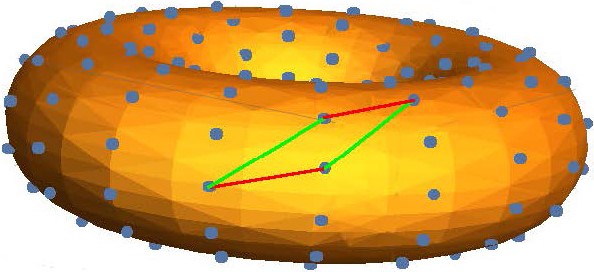
Use the complex-plane visualization to see a repeating elliptic-curve structure represented by cyclic vectors. section 3.1.2
