d3.forceManyBody() creates a force that changes how every node interacts with other nodes in a simulation. Use a negative value for repulsion, spreading nodes apart; use a positive value for attraction, drawing them together. section 12.4.1
Unlike positioning forces that pull nodes toward coordinates, a many-body force works between nodes. It is useful in a network layout, where repulsion can keep nodes from collapsing into the same area while other forces establish the overall arrangement. section 12.4.1 section 12.4.1
Reading the visible effect
In a force simulation, switching the many-body force from negative to positive changes the layout from nodes pushing apart to nodes pulling together. Combine it with forces such as centering, collision, and links to shape a network diagram. section 12.4.1 section 12.4.1
Figure 12.17 The many-body force influences how nodes interact with each other. A negative many-body force creates repulsion, while a positive one mimics attraction.
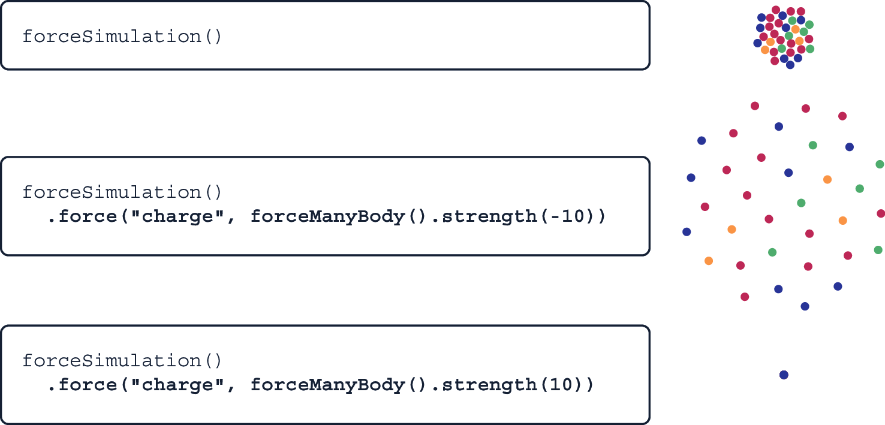
Compare the two force directions: negative strength produces repulsion, while positive strength produces attraction. section 12.4.1
