liveBook · Manning

DaemonSet

As explained in Acing the Certified Kubernetes Administrator Exam, Second Edition

A DaemonSet is a Kubernetes workload resource that ensures a pod runs on each eligible node.

A DaemonSet is a Kubernetes workload resource that ensures one pod runs on every eligible node. If its pod is deleted, the DaemonSet recreates it on a node missing that pod. section 4.1.1

Use a DaemonSet when a node-level component must run continuously across the cluster:

  • Run kube-proxy and container network interface components on each node. section 1.8
  • Inspect DaemonSets with kubectl get ds or kubectl get ds -A; compare desired, current, ready, and available counts. section 1.8
  • Inspect a DaemonSet pod's assigned node in its YAML by locating nodeName; retrieve pod names with kubectl get po -A. section 4.1.1

Distinguish kubelet from a DaemonSet

kubelet is a Linux background process managed on the host rather than by Kubernetes as a DaemonSet. Check it with systemctl list-unit-files --type service | grep kubelet -A3 -B3, then start it with systemctl start kubelet if it is stopped. section 1.8

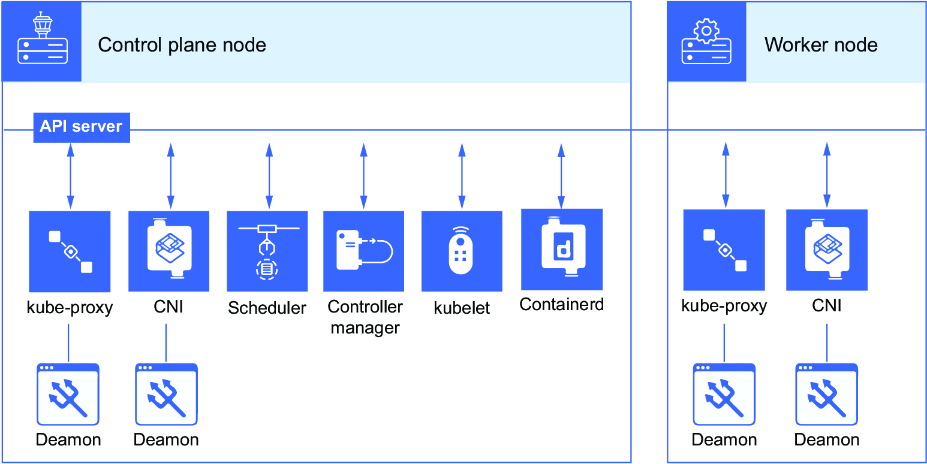
Figure 1.13 DaemonSets ensure that a single pod is running on each node in the cluster. kube-proxy and CNI both run as a DaemonSet.
figure

Use the diagram to visualize the one-pod-per-node placement pattern, including kube-proxy and CNI workloads. section 1.8


How Acing the Certified Kubernetes Administrator Exam, Second Edition covers it

How deep it goes
Explains one-pod-per-node scheduling, respawning, nodeName inspection, and kubectl verification, but not manifest construction.
Examples
Uses kube-proxy, CNI, kindnet, kubectl output, and kubelet systemd listings as operational examples.
What it assumes
Assumes basic Kubernetes pods and nodes, while clarifying the difference between Kubernetes DaemonSets and Linux background processes.
What you can do after
Diagnose DaemonSet coverage with kubectl and distinguish missing DaemonSet pods from a stopped host-level kubelet.
How it connects
Connects DaemonSets with pods, node names, node selectors, kube-proxy, CNI, and kubelet.

Also explained in

Compare how 3 books explain DaemonSet →

Related concepts

This explainer was generated by Manning's knowledge graph from the text of Acing the Certified Kubernetes Administrator Exam, Second Edition. The section links point to the parts of the book it draws on.
