Daily active users (DAU) counts unique users who make at least one production API call during a day. It is an activation metric: it tracks the move from evaluating an API to using it in a deployed application. Define “active” for your organization before comparing results; production API keys or tokens can identify usage, but an organization may require a completed business transaction instead. section 11.1.3
DAU counts users, not calls. When users are represented by API keys, the corresponding metric may be called daily active tokens (DAT). Weekly active users (WAU) and monthly active users (MAU) apply the same active-user definition over longer periods. section 11.1.3
Track production adoption
An API team aiming to grow monthly users by 10% next quarter treats DAU as a metric that can help drive that goal. For the Product Catalog API, it defines an active user as someone who makes a production API call, then uses Moesif report criteria for calls with an /api base path and views DAU as a time series. The chart shows whether daily production participation is changing; it does not, by itself, explain why. section 11.1.4
Figure 11.17 DAU criteria to show active users as those making API calls with an /api base path
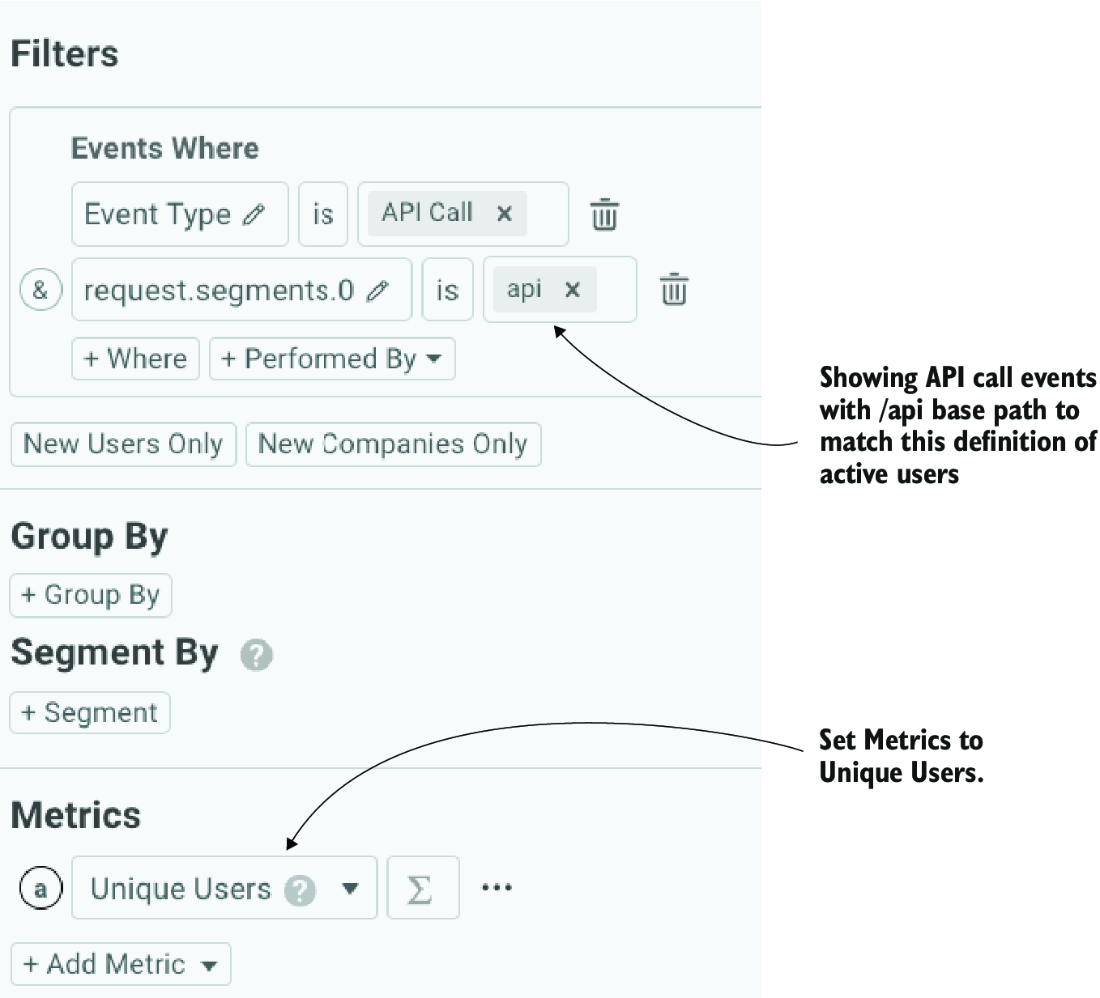
Shows the report criteria used to identify active users through API calls with an /api base path. section 11.1.4

