Promotion to CUDA Cores addresses numerical error in large low-precision matrix multiplications. When thousands of small products accumulate in a limited-precision register, underflow can distort the final result by as much as 2%. section 5.6.3
Tensor Cores perform fast, low-precision WGMMA multiplication and accumulation in bursts. At a fixed interval Nc, the partial sum is transferred to a CUDA Core and accumulated in a high-precision FP32 register. This periodic promotion preserves much of Tensor Core throughput while improving accumulation precision. section 5.6.3
Figure 5.30 The core strategy for increasing accumulation precision: intermediate results are periodically moved from the low-precision environment of the Tensor Cores to the high-precision environment of the CUDA Cores.
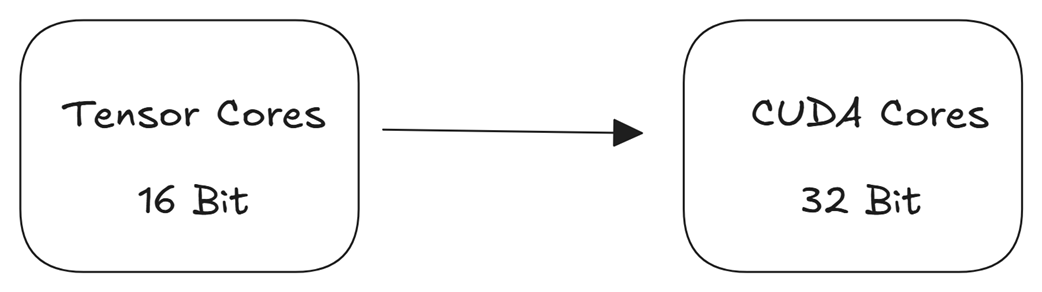
Visualizes the transfer path from low-precision Tensor Core accumulation to high-precision CUDA Core accumulation. section 5.6.3
Figure 5.31 The Increasing Accumulation Precision mechanism in detail. Low-precision accumulation happens in bursts on the Tensor Core, and results are periodically promoted to a high-precision FP32 register on the CUDA Core.
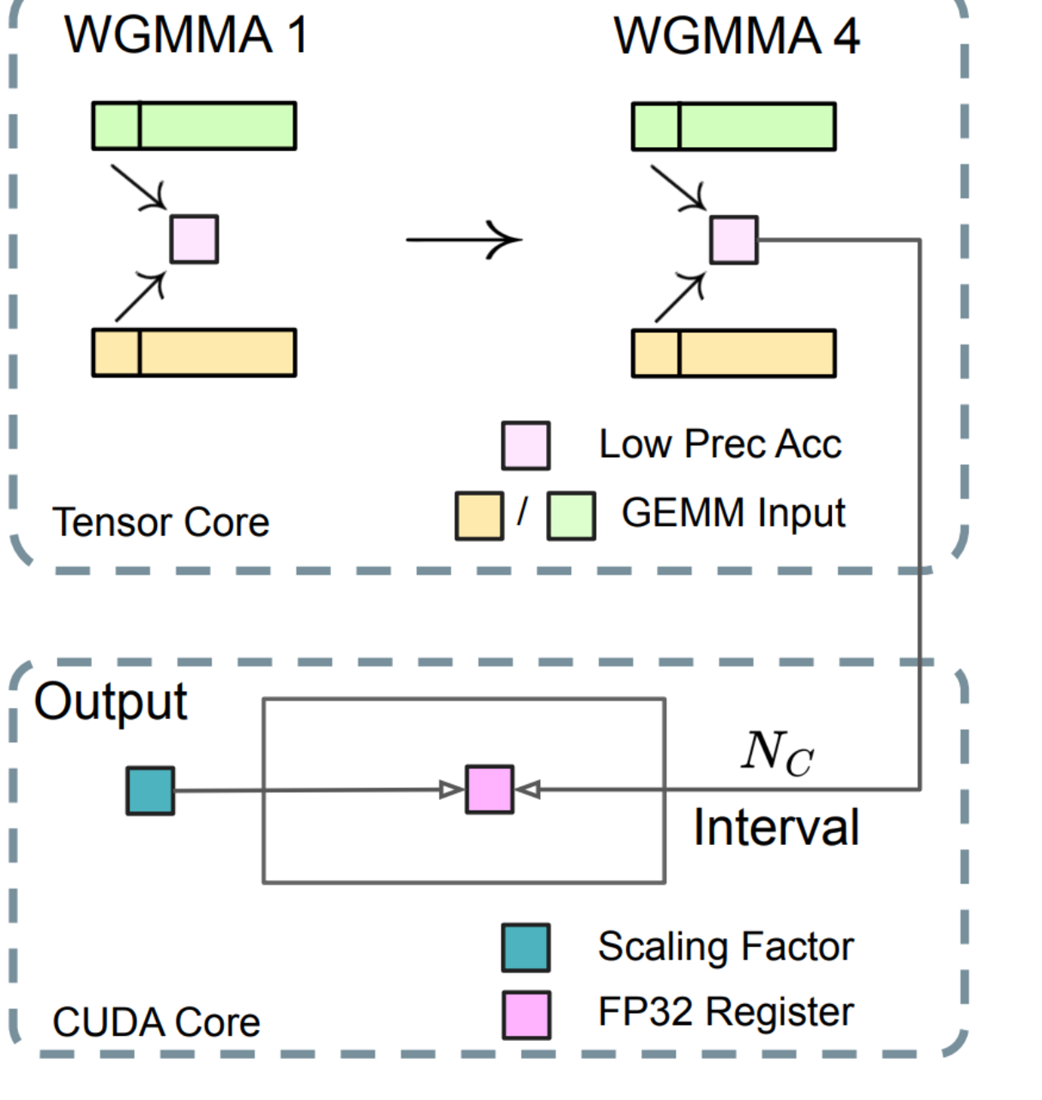
Details burst-based low-precision accumulation and periodic promotion into an FP32 CUDA Core register. section 5.6.3
