A Dapr resiliency policy applies failure-handling behavior to service-to-service and infrastructure interactions routed through Dapr. Services use Dapr service invocation APIs, while the daprd sidecar and platform configuration handle resiliency without custom application logic or added libraries. section 7.3.2 section 7.3.5
Use resiliency policies to:
- Apply consistent behavior between Dapr-enabled services through sidecar-mediated service invocation. section 7.3.2
- Cover interactions with infrastructure components such as state stores and PubSub components. section 7.3.5
- Let platform teams change resiliency configuration without adding dependencies or changing service code. section 7.3.2
- Rely on Dapr defaults when no custom resiliency configuration is provided. section 7.3.5
Conference service interactions
The Call for Proposals service can interact with the Agenda and Notifications services through Dapr service invocation. Resiliency policies are configured for those interactions, while Dapr also applies default policies when the application contacts the statestore or PubSub components. section 7.3.5
Figure 7.24 Service-to-service interactions can be handled by the daprd sidecar, allowing platform teams to define different resiliency policies.
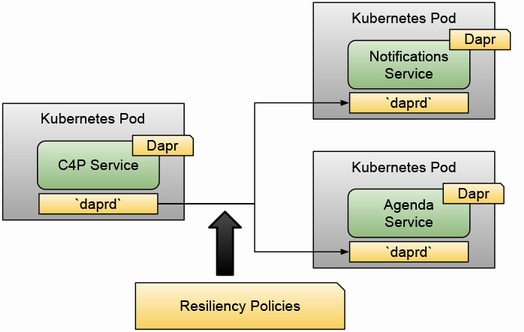
Shows how the daprd sidecar handles service-to-service interactions while platform teams define different resiliency policies. section 7.3.5
